Should you learn Chinese radicals first? Write the components, not the 214-radical list
Skip the 214-radical list. Practice writing the parts you actually use, including how 水 becomes 氵, and add each one when a character hands it to you.
On this page
A learner in the middle of HSK 1 asked on r/ChineseLanguage in early 2026 whether to learn about 200 radicals by name first, then treat every new character as a combination of those names.
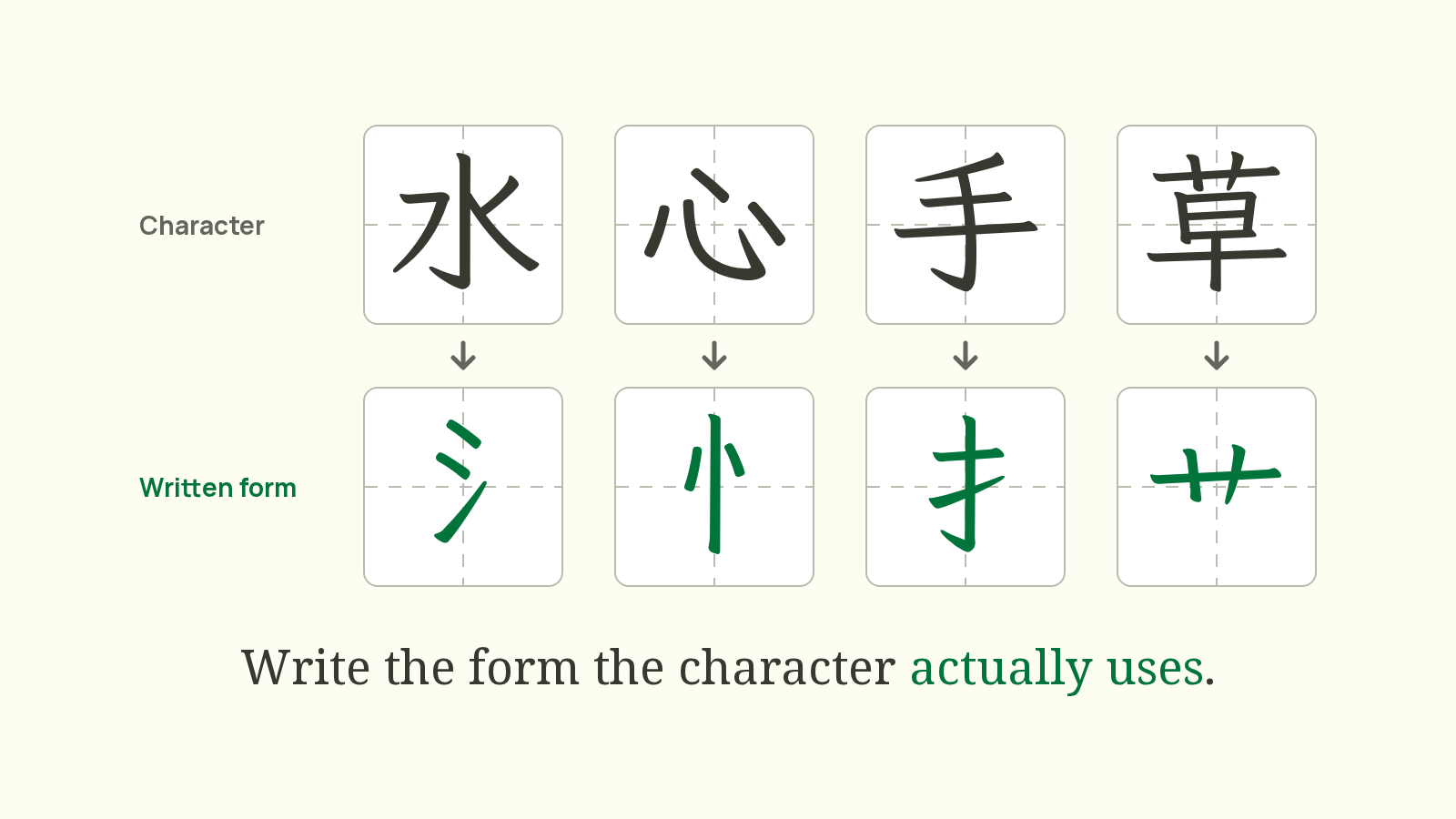
My answer is no. Don’t memorize the 214 Kangxi radicals as a list. A radical is a label a dictionary uses to file a character. What you write are components, and many change shape on the page: 水 turns into 氵 on the left, and 心 turns into 忄. Write a part when a character hands it to you, in the form that character uses.
Remembering a whole character is covered in how to memorize Chinese characters. This page is the reference for the parts and how they look when you write them.
The short answer: write the parts, not the 214 list
- A radical is the section heading a dictionary uses to file a character. It is not a list of the parts you will write, as Outlier Linguistics argues.
- What you write are components. Many have a standalone form and a squeezed form: 水 becomes 氵, 心 becomes 忄, 手 becomes 扌, and the top of 草 is 艹.
- You don’t need all 214 Kangxi radicals first. Oxford’s Chinese teaching centre says there is no need to learn all the radicals before learning characters.
- My working core is about 20-40 parts, counting their squeezed forms. There is no official count; one reply in an October 2026 practice thread suggested about 50.
- Practice a part inside the character that introduced it, then watch for it again. Don’t practice by reciting a list of names.
Each point has its own section below. The memorize post makes the same call: learn components as you meet them, not the radical list as homework.
A radical is a dictionary label. A component is what you write
Chinese calls a radical 部首, bùshǒu, “section head”. A dictionary sorts characters into sections by one shared part, then by stroke count. The heading of each section is the radical.
The familiar set of 214 is named for the Kangxi Dictionary of 1716, and since 2009 mainland China has promoted a 201-radical system for simplified characters, according to Wikipedia’s summary of the Kangxi radicals. The filing isn’t fixed either: Oxford’s radical index notes that one character can sit under different radicals in different dictionaries.
Each character gets one radical for filing, however many parts it has, and the radical is not always the part that carries the meaning. Outlier’s example is 到, “to arrive”. Its radical is 刂, the knife, but there 刂 is the sound hint, and 至 carries the meaning.
Components do the real work, as meaning parts, sound parts, or sometimes just shapes. Hacking Chinese describes “radical” as a job a component has inside one character, and notes that many common components are never radicals. For meaning parts and sound parts, with 妈 as 女 plus 马, see the memorize post.
One limit: this post doesn’t reconstruct character history. The 灬 at the bottom of 熊 looks like fire, but Hacking Chinese says it isn’t. For handwriting, you write the form on the page today.
The parts change shape when you write them
This is the part a radical list skips. A list files 氵 under 水. Your hand has to write 氵, narrow, beside the rest of 河.
The shapeshifts you will write all the time
Four pairs come up first:
- 水 becomes 氵, 三点水, “three drops of water”: 河, 清, 没. The last drop rises toward the right part.
- 心 becomes 忄, 竖心旁, on the left: 情, 忙, 快. At the bottom, 心 usually keeps its full form, as in 想 and 念. A rarer bottom form, ⺗, shows up in 慕.
- 手 becomes 扌, 提手旁: 打, 把, 找.
- 艹, 草字头, “the top of 草”: 花, 茶, 菜. Its old standalone form, 艸, is rare, so the name uses 草.
A second group you will write often:
- 人 becomes 亻: 你, 他.
- 言 becomes 讠: 说, 请.
- 刀 becomes 刂, on the right: 别, 到.
- 火 becomes 灬, at the bottom: 热, 照, 煮.
- 食 becomes 饣: 饭, 馆. 金 becomes 钅: 钱, 银. Traditional keeps fuller forms; this post uses simplified.
- 示 becomes 礻: 礼, 福. 衣 becomes 衤: 裤, 衬.
- 犬 becomes 犭: 狗, 猫.
- 玉 is written like 王 on the left: 玩, 现.
Hacking Chinese’s shapeshifting guide has a longer list. These parts usually carry the meanings in the table below, but some characters use them only for sound or shape, so check a dictionary before you build a memory on an example.
Squeezed is not the same as shapeshifted, and width is a handwriting problem
Other parts keep the same strokes and just get smaller. Hacking Chinese calls these essentially identical, with 口 in 喝 and 子 in 好 as examples. For reading, they’re the easy cases. For writing, they still matter, because the parts share one square.
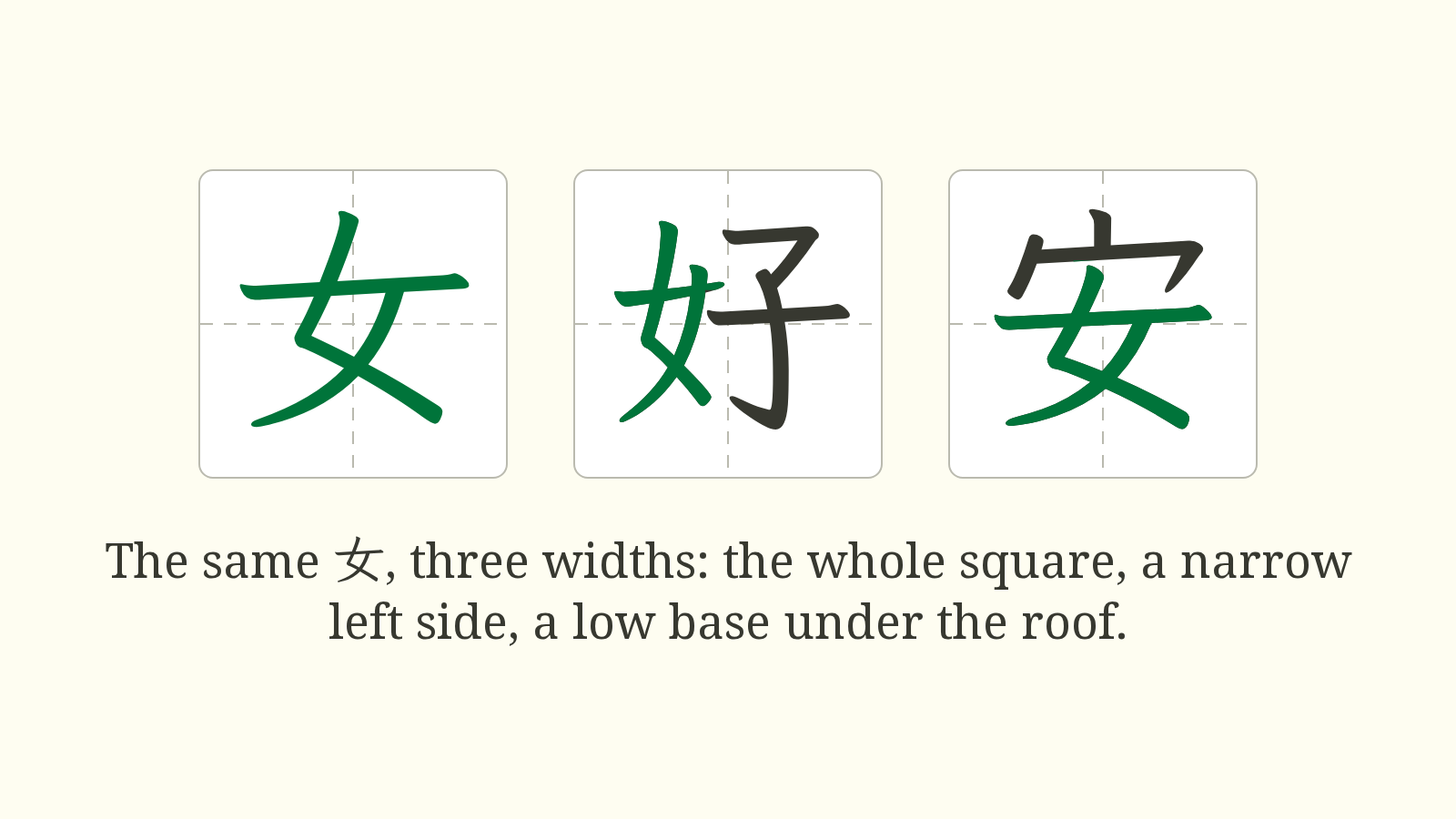
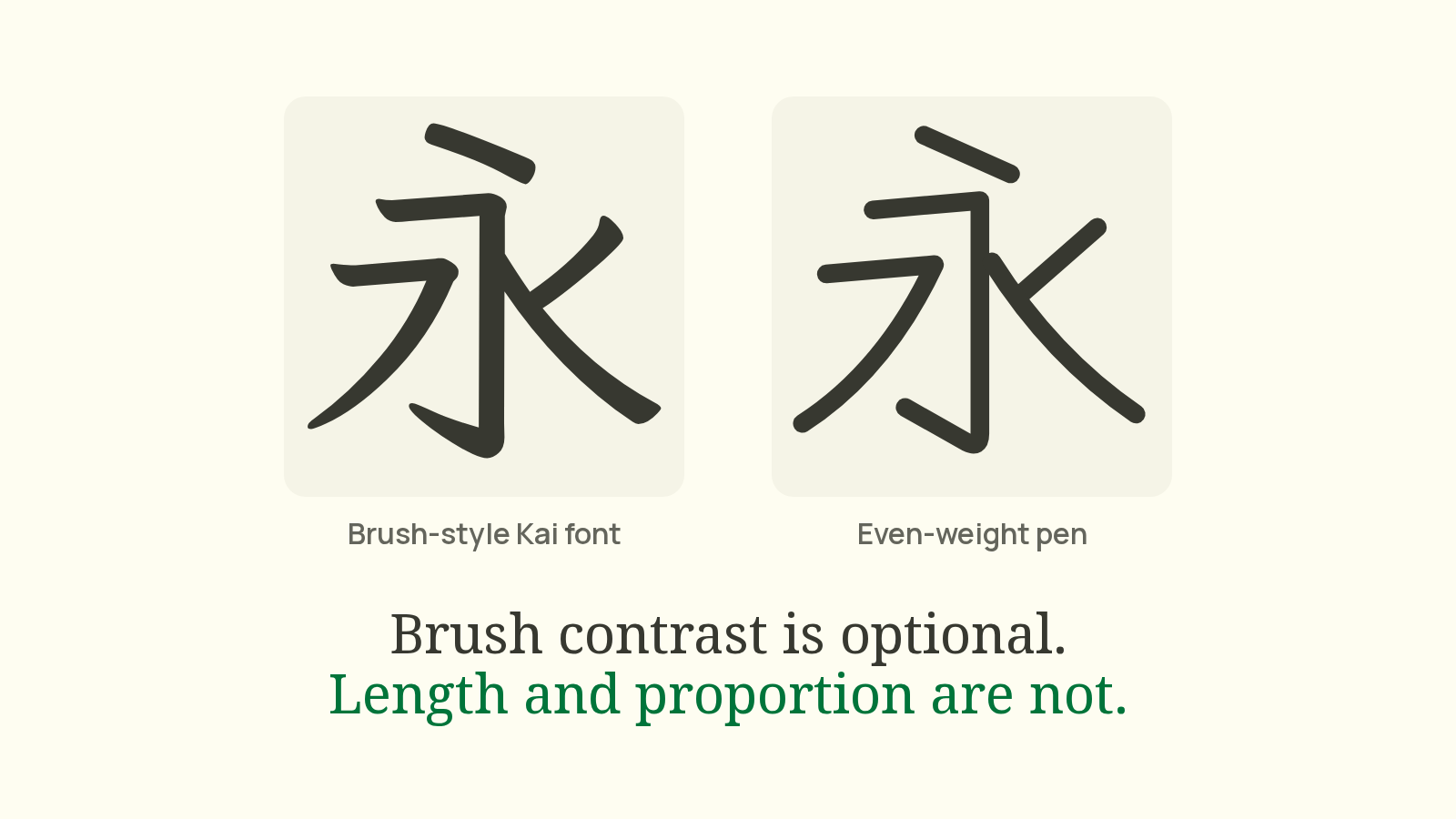
女 shows the problem. Alone, it fills the square. On the left of 好 or 妈, it takes a narrow share, and in most regular-script models its last stroke tilts up so it doesn’t run into the right part. Under the roof in 安, it sits low and spreads wide. Writing 女 the same width in all three is a proportion problem, not a vocabulary problem.
Learners ask whether every character needs the same width. Inside one character, the parts have to split that width between them.
Some names tell you the change: 提土旁, the 土 on the left of 地, is named for its rising last stroke. Others don’t: 木 on the left of 林 ends in a dot to make room, but its name is just 木字旁. I covered that, and why components share the box, in the post on messy handwriting.
A few look the same, or look related, but aren’t
彳, the left side of 行, looks like 亻 with an extra stroke, and its nickname 双人旁, “double person side”, makes it sound related. Hacking Chinese notes it has nothing to do with 人. The 月 on the left of 胖 and 脸 comes from 肉, flesh, not the moon.
Some pairs differ by a single stroke, and your hand has to know which one it is writing. 礻 in 礼 has one short stroke after the vertical; 衤 in 裤 has two, a short sweep and a dot. 冫 in 冷 has two drops; 氵 in 河 has three. 宀 in 家 has a dot on top; 冖 in 写 doesn’t.
For writing, copy the model, and don’t assume two look-alike left sides are the same part.
The 20-40 parts you will write constantly
There is no official number to learn. The 214 Kangxi radicals are a dictionary inventory, not a writing syllabus, and Outlier’s advice is to study functional components instead.
My working answer is about 20-40 parts that show up constantly in beginner writing, counting squeezed forms. That’s my estimate, not a research figure. A reply in the October practice thread suggested about 50; treat that as a ceiling, not homework.
The table groups parts by where you write them. Practice each one the first time it turns up in a real character.
| Where | Standalone | Written form | Common name | Usually about | Write it in |
|---|---|---|---|---|---|
| Left | 人 | 亻 | 单人旁 | people | 你, 他 |
| Left | (none) | 彳 | 双人旁 | walking, going | 往, 很 |
| Left | 水 | 氵 | 三点水 | water, liquid | 河, 清 |
| Left | 手 | 扌 | 提手旁 | things you do by hand | 打, 找 |
| Left | 心 | 忄 | 竖心旁 | feelings | 情, 忙 |
| Left | 言 | 讠 | 言字旁 | speech | 说, 请 |
| Left | 食 | 饣 | 食字旁 | food | 饭, 馆 |
| Left | 金 | 钅 | 金字旁 | metal, money | 钱, 银 |
| Left | 糸, rare | 纟 | 绞丝旁 | thread, silk | 红, 绿 |
| Left | 示 | 礻 | 示字旁 | rites, blessings | 礼, 福 |
| Left | 衣 | 衤 | 衣字旁 | clothing | 裤, 衬 |
| Left | 犬 | 犭 | 反犬旁 | animals | 狗, 猫 |
| Left | 玉 | 王, last stroke rises | 王字旁 | jade, precious things | 玩, 现 |
| Left | 女 | 女, narrow | 女字旁 | women, family | 妈, 姐 |
| Left | 口 | 口, smaller | 口字旁 | mouth, sounds | 吃, 叫 |
| Left | 木 | 木, last stroke a dot | 木字旁 | trees, wood | 林, 树 |
| Left | 土 | 土, last stroke rises | 提土旁 | earth, ground | 地, 城 |
| Left | 阜, rare | 阝 | 左耳刀 | hills, places | 阳, 院 |
| Right | 刀 | 刂 | 立刀旁 | knives, cutting | 别, 刻 |
| Right | 邑, rare | 阝 | 右耳刀 | towns, places | 都, 部 |
| Top | 艸, rare | 艹 | 草字头 | plants | 花, 茶 |
| Top | (none) | 宀 | 宝盖头 | roofs, houses | 家, 安 |
| Top | 竹 | ⺮ | 竹字头 | bamboo | 笔, 筷 |
| Bottom | 心 | 心, flatter | 心字底 | thinking, feeling | 想, 念 |
| Bottom | 火 | 灬 | 四点底 | fire, heat | 热, 照 |
| Frame | 门 | 门 | 门字框 | doors, or a sound hint | 间, 问 |
| Frame | 辵, rare | 辶 | 走之底 | moving | 过, 进 |
| Frame | 囗, rare | 囗 | 国字框 | enclosures | 国, 园 |
Read “usually about” as a tendency. Use the names to search or to ask a teacher, and treat the table as a field guide, not a syllabus.
A phonetic-series walkthrough you can actually write: 青, 马, 门
Many characters pair a meaning part with a sound part, and the sound part is a hint, not a spelling. The memorize post has the 马 and 青 sound families with their tones. The question here is how a series sits in the square once a shapeshifted part is on the left, or a frame wraps the inner part.
青: a stable right side, a changing left
清 qīng, 情 qíng, 请 qǐng, 晴 qíng. 青 keeps the same block on the right each time. The left part changes: 氵, 忄, 讠, 日. Each of those is narrow, so 青 gets most of the width. Write 青 the same way in all four and spend your attention on the left side.
The sound hint can slip: 睛, “eyeball”, is jīng, and so is 精, with 米 on the left.
马: the sound part needs its share
妈 mā, 吗 ma, 码 mǎ, 骂 mà. Here 马 is the sound part, and it needs enough of the square for its turns and the hook at the bottom. 女, 口 and 石 on the left have to stay narrow to leave it room. 骂 changes the layout. Two 口 sit on top, and 马 goes underneath, flatter and wider.
门: a frame, not a side
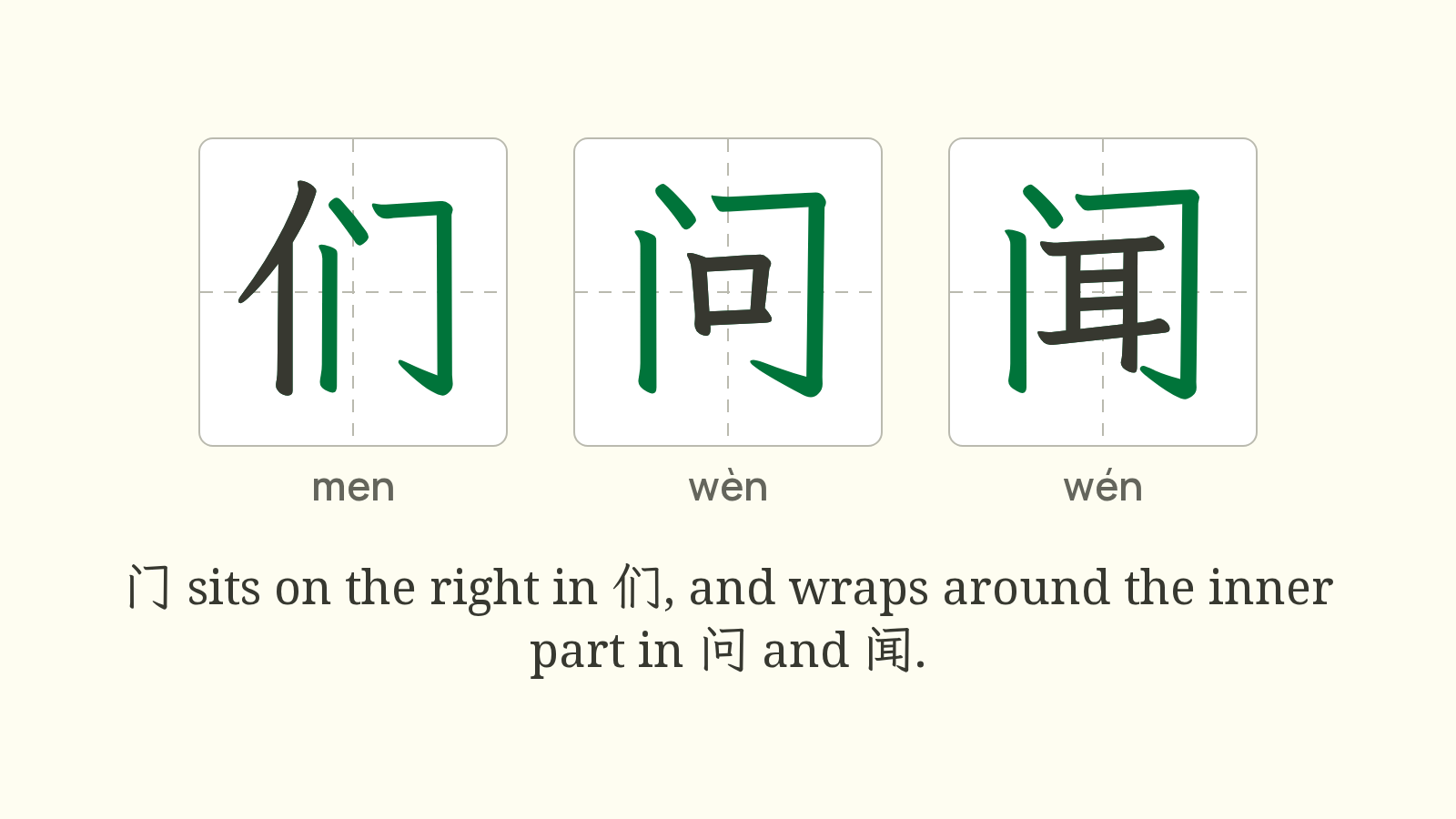
门 does a different job. In 们 men, 门 is squeezed on the right beside 亻, the way 马 sits in 妈. In 问 wèn and 闻 wén, 门 becomes a frame, and the meaning part goes inside it: 口 in 问, 耳 in 闻. 闷 mèn, “stuffy”, puts 心 inside. The hint points at the -en sound. The first letter and the tone move.
A frame is a different handwriting problem from a left side. Write 门 first, outside before inside, then keep the inner part small enough to sit in the middle without touching the frame.
Not every 门 is a sound hint: 间 jiān, “between”, sounds nothing like mén.
My rule for any series: when a new character is clearly a part you know plus a part you know, write the two parts into one cell and check the squeezed or framed form against the model. Then cover the model and write the whole character from memory. Writing from memory beats tracing, so don’t skip that last step.
How to practice the parts, without starting a second method
Next time a character hands you an unfamiliar part, stop and write that part a few times. First the standalone form, if it has one. Then the squeezed form the character uses. Then the whole character from memory. You are making the part easy to produce, not collecting radicals.
If you already use the five-step method in how to memorize Chinese characters, keep it; this rule fits inside its first step. Write on a blank page, as in writing from memory versus tracing, and keep the session short, as in Hanzi writing on iPad.
If you practice in Strokie, character practice gives you guided cells to trace, then free cells to write in. The recall quiz shows the pinyin and meaning, and you write the character from memory, then check it. The stroke-order glossary can replay a whole character’s strokes when you need the model again. Auto-grading checks whether your stroke count matches and your overall shape is close enough. It doesn’t check stroke order or line thickness. You can practice on iPad with a stylus, and the same practice squares are on Android tablets.
FAQ
How many radicals should I learn?
Not 214, and not as a list. Start with the parts in the table as they come up. About 20-40 feel constant in beginner writing, and one learner suggested about 50. There is no official target, though learners keep asking for one.
Should I learn all the radical names first?
No. A name like 三点水 is handy once you have written 氵 a few times. Reciting names won’t teach your hand the squeezed forms. Learners asked this in early 2026 and again in June 2026, and my answer matches the memorize post’s FAQ.
Are phonetic components the same as radicals?
No. A phonetic component is a sound hint, like 青, 马 or 门 in the series above. A radical is a dictionary filing label. Sometimes one piece does both: in 到, 刂 is the radical and the sound hint. Often they are different parts.
Sources
- Outlier Linguistics, John Renfroe, “Chinese Character Radicals. Don’t Do It.” (April 14, 2023)
- Hacking Chinese, “Shapeshifting Chinese characters”
- Hacking Chinese, “The building blocks of Chinese, part 2: Basic characters, components and radicals”
- University of Oxford, Centre for Teaching Chinese as a Foreign Language, “Chinese Characters and Radicals”
- Wikipedia, “Kangxi radical” (reference summary, secondary)
- r/ChineseLanguage thread, learning radicals first (learner discussion, early 2026)
- r/ChineseLanguage thread, how many radicals should I learn (learner discussion)
- r/ChineseLanguage thread, should I learn all the radicals (learner discussion, June 2026)
- r/ChineseLanguage thread, character writing practice (learner discussion, October 2026)
- r/ChineseLanguage thread, how essential is it that each character has the same width (learner discussion, early 2026)
Put the method into practice.
Practice each new part inside a real character. Trace it, write it in a blank square, then quiz yourself on the ones that slip.