Do you still need to learn to write Chinese characters by hand?
Write a bounded core of Chinese characters by hand; type the rest. Memory benefits, character amnesia, and the HSK 3.0 writing list.
On this page
A learner asked in r/ChineseLanguage on October 20, 2026 whether handwriting Chinese characters is still worthwhile. The poster argued that recognition and building sentences matter more, since nearly everything now goes through a pinyin keyboard. Replies pushed back that writing helps memory, and native speakers brought up 提笔忘字, forgetting a character the moment you pick up the pen.
My answer: you do not need to handwrite every character you can read. You do need a core set you can write from memory. Type the rest. The exam world has already drawn that line: Chinese Testing International set the worldwide launch of HSK 3.0 for December 13, 2026, and its syllabus separates characters you must write from ones you only recognize.
The short answer: write a core set, type the rest
- Most everyday Chinese output is typed, usually through pinyin, not handwritten.
- Handwriting still strengthens how well you remember a character’s form and meaning.
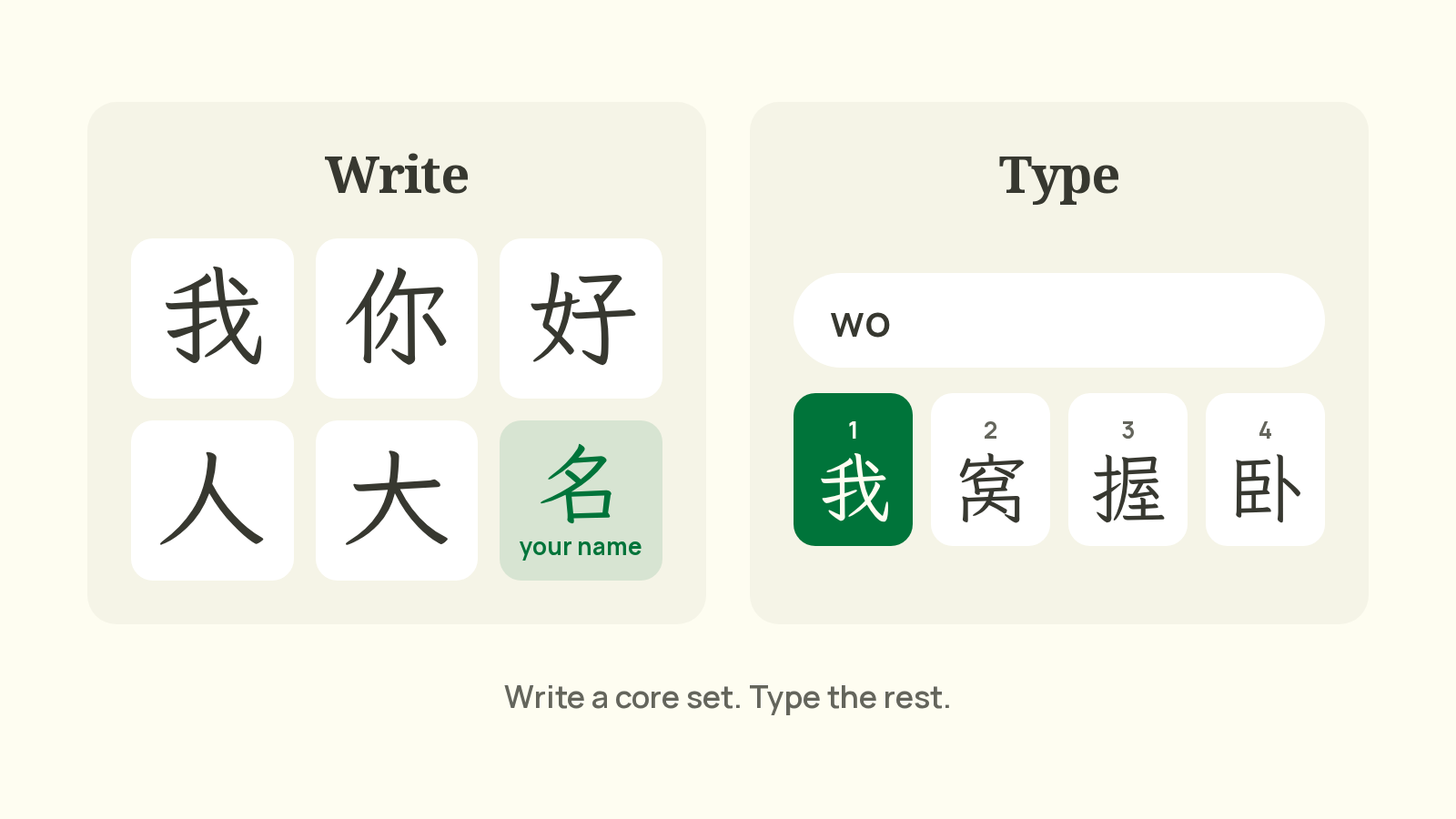
- Bound the handwriting set: the exam writing list, look-alikes you confuse, and your personal must-writes, such as your Chinese name.
- Type everything outside that set.
- Practice the core from memory, not by endless copying.
Each point has its own section below. The set can stay small because reading and writing are separate counts.
What typing already covers, and what it does not
Phones and computers are the usual way to produce Chinese now. Handwriting turns up on forms, paper exams, whiteboards, and the occasional note. That is practitioner testimony from the thread above and from Hacking Chinese, whose author lived in Taiwan for four years and says he rarely had to write by hand outside language schools and universities, and could have looked characters up on his phone when he did. It is not a measured share of anyone’s output, so I will not put a percentage on it.
My rough sort, from those sources rather than a survey:
| Situation | Can you type or look it up? |
|---|---|
| Messages, documents, and search | Yes, typing is the normal route |
| Paper exams | No, you write it yourself |
| Forms, addresses, and notes | Usually, with a phone nearby |
| Classroom or whiteboard | Often, though handwriting is faster there |
Typing and writing ask for different things. To type 我, you need to recognize it and know its sound, then pick it from a list of candidates. To write 我, you must produce the whole form yourself, with nothing to pick from. Hacking Chinese makes the same point: phonetic typing does not reinforce structure, components, or the ability to keep similar characters apart.
This is why even native speakers slip. Hacking Chinese gives the classic example, 嚏 in 打喷嚏, “to sneeze”: students can usually write it, but adults a decade or more past graduation often cannot.
One opinion from X is worth a line, as opinion and not evidence: a post on October 14, 2026 says writing is “the least important part” of learning Chinese, and that natives forget characters too. The studies below back the second half. The first half depends on your goal.
What research says handwriting still does for learners
Form-meaning gets stronger when you write
The closest study to this question that I know is by Guan, Liu, Chan, Ye and Perfetti, published in 2011. It tested adult learners of Chinese in two studies. A tutor that included handwriting was compared with a reading-only tutor. The handwriting condition did better on word recognition and on the link between a character and its meaning, but not on the link between a character and its sound.
In the second study, the authors added pinyin typing. Typing supported the sound link and left the writing effect in place. Their practical conclusion was to combine handwriting with pinyin typing.
The authors suggest the writing effect comes from refining the visual-spatial information a character needs, plus a sensory-motor memory that comes with moving your hand. That is the authors’ proposed mechanism, not a separate finding.
One caveat: these were adult learners working with a tutor program. The study does not say handwriting is required for every character.
A 2026 follow-up points the same way
A 2026 study in Foreign Language Annals randomly assigned 28 Burmese beginners to a handwriting group or a typing group, 14 each, with 40 hours of instruction. The typing group did better on character recognition and dictation, which the authors read as form-to-sound mapping. The handwriting group did better on meaning recognition. There was no significant difference in meaning-based output.
The authors suggest typing early for form and sound, with targeted handwriting for form and meaning. I have read the abstract only, not the full paper. The sample is small, from one language background, and made up of beginners, so treat it as a direction and not a verdict.
What this does not mean
It does not mean you should handwrite every character you meet. Hacking Chinese puts the cost plainly: deeper processing is better, but it takes much longer, and those are hours you could spend reading and listening. The same article calls learning to write every character by hand “a bad idea”.
The method for the characters you do write lives in other posts. How to memorize Chinese characters covers parts, a story, and the first cold write. Why writing from memory beats tracing covers why a blank page tests more than a copy.
Character amnesia is real, and it argues for a smaller writing set
Character amnesia, or 提笔忘字, is when you recognize a character and know the word but cannot fully write it by hand.
A 2021 mega-study in Language Sciences analyzed a large handwriting database. Among university students, character amnesia occurred for about 42% of characters and about 6% of the time. It was more likely for characters that were less frequent, embedded in a less familiar word, acquired later in life, or made of more strokes. Frequency, how familiar the word was, and age of acquisition were the strongest predictors.
A companion study on tip-of-the-pen states had 64 participants handwrite 200 simplified characters. People with more digital exposure and less pen exposure had more retrieval failures. That is an association, not proof that typing causes forgetting.
A modest counterweight: Guy Almog argues in The China Quarterly that the bulk of the evidence cited in the public alarm over “character amnesia” is unreliable or invalid. His critique appeared in 2019, before the studies above. So my claim stays modest: amnesia happens, frequency and practice predict it, and none of this shows that learners must handwrite thousands of characters.
That tells you where handwriting time goes furthest. Frequent characters in words you know well hold up. Rare characters in unfamiliar words fade first, so they cost the most to keep by hand. That is my inference from the predictors, not something the studies tested. If even native speakers lose rare forms, “write everything I can read” is the wrong goal. Protect a high-value core instead.
A concrete “write this / type that” split
| Write from memory | Type (recognize and select) |
|---|---|
| Your level’s HSK writing list | The rest of your recognition vocabulary |
| Look-alikes you keep mixing up, such as 土 and 士, or 未 and 末 | Rare names, place names, and specialty jargon |
| Your Chinese name and a few form-filling staples | Anything you only need to read |
| Characters that appear in many words you use | Characters you meet once in a graded reader |
For the exam default, use the writing list in the 2025 syllabus. Recognition lists are much larger than writing lists, as the table shows. How many Chinese characters you need has the full tables.
| HSK 3.0 level | Characters to recognize | Characters to write |
|---|---|---|
| 3 | 655 | 250 |
| 6 | 1,940 | 700 |
| 7-9 | about 3,000 | 1,200 |
Counts are cumulative, from the 2025 syllabus that HSK 3.0 uses from its December 13, 2026 launch.
The exam list is a default, not a frequency ranking. 看, 就, 想, 能, and 到 appear on none of the official writing lists, as I show in the how-many post. So a character you use daily may be missing from the exam core, and that is a reason to add it yourself.
Ask three questions about any character. Is it on your level’s writing list? Have you written it wrong, or confused it with a twin, recently? Will you need to produce it without a phone? A yes to any of them puts it in your core. Otherwise, type it.
For look-alike pairs worth adding, see why your Chinese handwriting looks messy. My rule, and it is only an opinion: start with the exam list for your level, then add only what you actually forget.
HSK 3.0 makes the split official
As of November 12, 2026, the Chinese Testing International notice says HSK 3.0 launches worldwide on December 13, 2026. The notice gives two registration deadlines, both in Beijing time.
| Test form | Registration closes |
|---|---|
| Paper-based | 24:00 on November 16, 2026 |
| Computer-based | 24:00 on December 3, 2026 |
Paper registration closes almost four weeks before test day, so paper candidates have to decide first. Check the notice before you book, because dates like these move.
The official syllabus prints 认读字, characters you recognize, and 书写字, characters you write, as separate lists. That is this post’s thesis in institutional form: you read far more than you write. Even if you never sit the exam, the writing list is a ready-made core.
On the paper test, the official sample papers ask for handwriting from level 2, and the how-many post lists each level’s writing tasks. Test-takers report that the computer version uses pinyin input, but I have not found an official statement confirming it. If your test center offers paper only, the writing list matters in the most literal way.
Hacking Chinese says the HSK 3.0 writing standard “makes a lot of sense”, and suggests learning the list, then letting the rarer or harder characters go over time if you never need them. That is a teacher’s view, not an exam rule.
How to practice the core without burning your other study time
Keep it short. Pick today’s core characters. Write each from its pinyin and meaning, with the Hanzi hidden. Check it, then fix the one part you missed. Space the reviews out. The details are in a short daily session, writing from memory versus tracing, and Hanzi writing on iPad.
One rule of mine: if a character is outside your writing set, meeting it while reading and being able to type it is enough for now. You can always promote it later.
Every character you add to the core also adds reviews, so add a few at a time. The per-day arithmetic is in the memorize post.
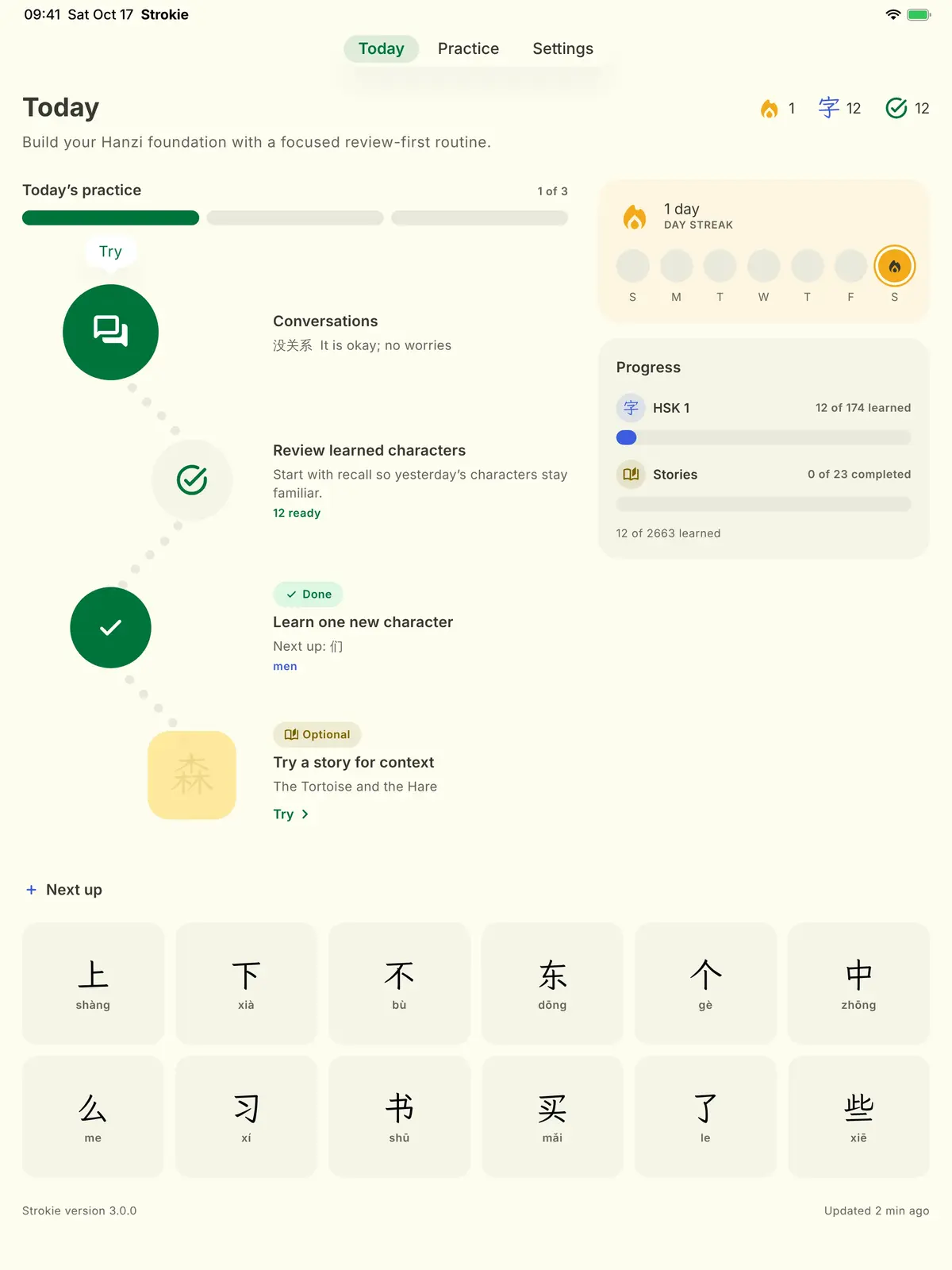
Strokie is a tool for practicing writing Hanzi so a core set sticks. Character practice gives you guided tracing cells, then free cells. The recall quiz shows the pinyin and meaning, and you write the character from memory. Then you reveal the answer and mark it yourself, or let auto-grading compare your stroke count and overall shape with the model. Characters you miss come back first. The glossary replays the strokes when you need the model again.
FAQ
Can I skip handwriting entirely?
Yes, if you only want spoken Chinese and typed chat, and you are not sitting a paper exam. You will still need to read characters. Hacking Chinese reaches the same place: for most learners, writing by hand is optional in daily life, and reading and typing are not. You can also add handwriting later if your goals change.
When should I start characters at all?
As early as you can stand, for reading. Handwriting can lag behind recognition, and a character you can read and type is already useful. Teachers disagree on timing: Hacking Chinese would build spoken Chinese first, but it also puts handwriting after reading. Learners ask this often, including in a thread on November 7, 2026. For the method once you start, see how to memorize Chinese characters.
How many characters should I write by hand?
Your HSK writing band, or a personal core of a few hundred, not your whole recognition vocabulary. Grow the list only where characters keep slipping. That is my opinion, anchored on the official writing lists. The per-level counts are in how many Chinese characters you need.
Sources
- Chinese Testing International notice, HSK 3.0 launch and registration (checked November 12, 2026)
- Official Chinese Proficiency Test syllabus, published 2025
- Official HSK 3.0 sample papers
- Guan, Liu, Chan, Ye and Perfetti 2011, writing and Pinyin typing in learning to read Chinese
- Shi, Hu and Zhu 2026, typing and handwriting in Chinese character learning
- Huang et al. 2021, character amnesia in Chinese handwriting
- Huang et al. 2021, tip-of-the-pen states in Chinese handwriting
- Almog, reassessing the evidence of Chinese character amnesia
- Hacking Chinese, is it necessary to learn to write Chinese characters by hand?
- r/ChineseLanguage thread, is handwriting Chinese characters still worthwhile (learner discussion, October 2026)
- r/ChineseLanguage thread, when is the right time to learn Hanzi (learner discussion, November 2026)
- X post by @grapefruitism, October 14, 2026 (opinion)
Put the method into practice.
Practice the characters you chose to write on iPad: trace, write from memory, and repeat the ones that slip.