Does stroke order matter in Chinese? Yes, but here's what you can let go
Yes, for neat, readable characters and for memory. The rules that cover most characters, what research found, and which differences you can ignore.
On this page
Yes, stroke order matters if you are learning Chinese. It shapes how neat and readable your characters are, it helps you read other people’s handwriting, and in two recent studies it helped learners remember and write characters. But you will not be marked wrong for every regional variant.
“U can tell how chinese an artist is by seeing how they draw a square.” That X post went up on Nov 3, 2026 and had more than 112,000 likes when I checked on Nov 6, 2026. As I read the replies, the joke is that people who learned Chinese draw a square the way they write 口.
Why you can spot a Chinese writer by their square
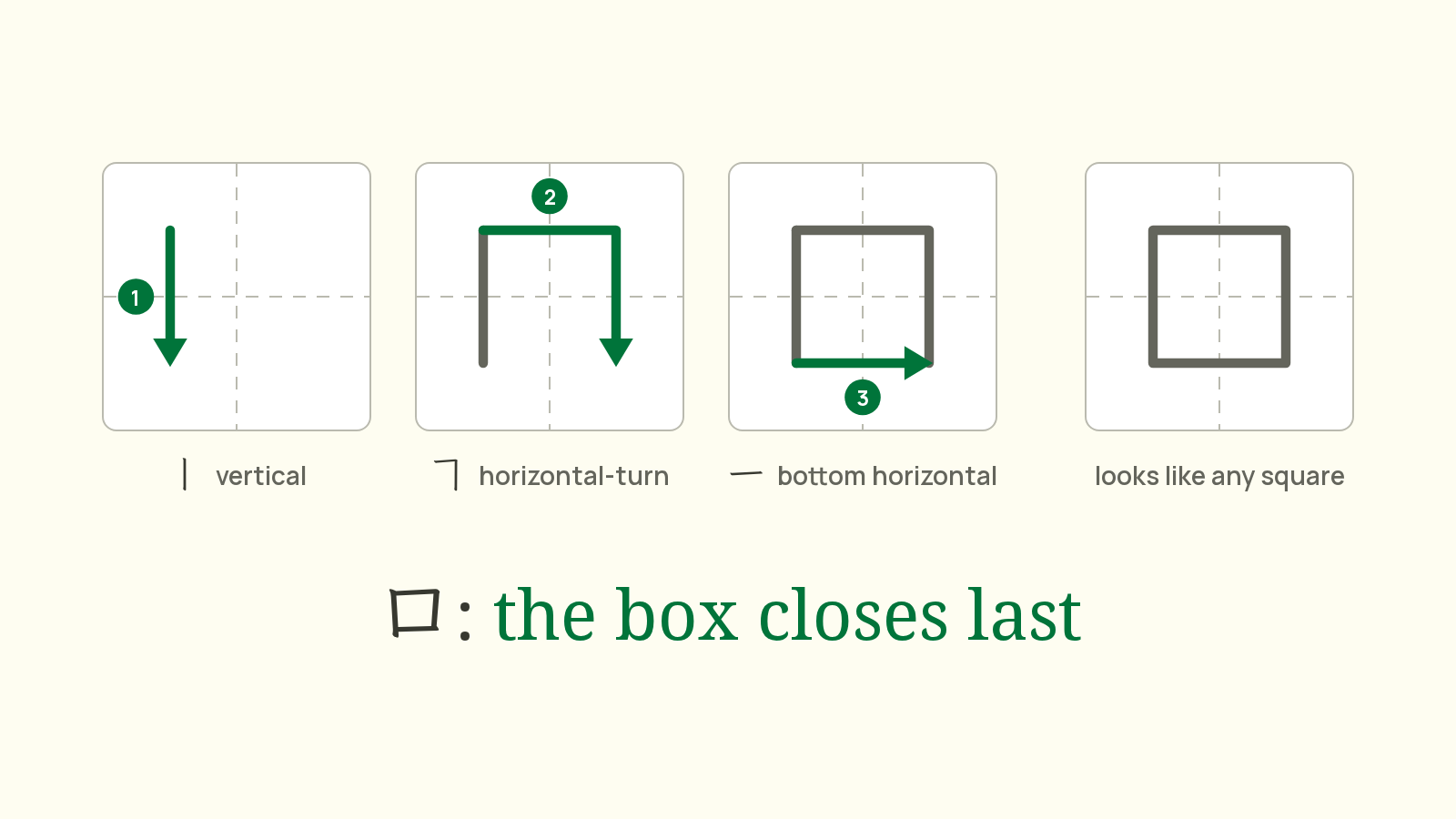
口 takes three strokes, in this order: a vertical 丨, a horizontal-turn 𠃍, and a bottom horizontal 一. The box closes last. Both the mainland and the Taiwan standards give the same order for it.
That is the “enclose, fill, then close” rule. Taiwan’s Ministry of Education lists it as “bottom strokes of enclosures last”, with 日, 田, 回 and 國 as examples (Taiwan MoE FAQ). The mainland standard GF 0023-2020 writes 日, 田 and 回 the same way (GF 0023-2020).
口 turns up in a huge number of common characters, from 叫 and 吃 to 品 and 回. You write that box so often that its order leaks into everything you draw, squares included.
What stroke order actually does for you
Shape and balance. Order is what keeps a character in proportion. Each stroke starts close to where the last one ended, so the parts land where they should. If your characters still look off, check the proportions next.
Reading handwriting. In fast writing, strokes run together. Learners and native speakers in the Reddit threads say that knowing the order is how you decode a scrawl (thread one, thread two). That is practitioner advice, not research.
Dictionaries. Stroke order is also a filing system: the mainland standard gives the order for all 8,105 characters of the 通用规范汉字表 and sorts them by stroke sequence under GB 13000.1 (GF 0023-2020).
Memory. This is the part with research behind it. Two 2024 studies by Sun, Wang and Yu used a computer-assisted learning system with learners of Chinese as a second language. Each compared correct stroke order, random order and no order at all.
- In the recognition study, correct order gave shorter response times and higher accuracy, in both immediate and delayed tests. The effect was stronger for complex characters (System, 2024).
- In the writing study, correct order gave higher writing accuracy, especially for characters with fewer strokes. It may also have made writing faster, but that was only a trend. The authors’ summary is that order matters more for writing correctly than for writing quickly (CALL, 2024).
Both were lab studies on a computer, from one research group, and other lab work is mixed: Hou and Jiang found lower recognition accuracy for learners who watched stroke-order animations while studying (Frontiers in Psychology, 2022).
Knowing the order will not keep look-alikes apart, either. In a study by Chang and colleagues, learners who studied look-alike characters with a stroke-sequence-only strategy wrote them less accurately right after learning than learners who added key images, a hook based on meaning (Frontiers in Psychology, 2022). Stroke order is how you write a character. It is not how you remember which character is which.
The rules that cover most characters
You do not need a rulebook, but eight rules handle most of what you will meet. Taiwan’s Ministry of Education lists 17 basic rules (Taiwan MoE FAQ), and I checked every example below against Taiwan’s data and the mainland standard (GF 0023-2020).
| Rule | Examples |
|---|---|
| Top before bottom | 三, 字 |
| Left before right | 川, 仁 |
| Horizontal before vertical when they cross | 十, 干 |
| Left-falling (丿) before right-falling (㇏) | 人, 入 |
| Outside before inside | 月, 问 |
| Fill the enclosure before you close it | 日, 田, 回 |
| Middle before the sides | 小, 水 |
| A stroke that cuts through everything goes last | 中, 女 |
In 中 the vertical goes last. In 女 the horizontal goes last. Rules have exceptions, so when in doubt, look the character up once instead of guessing. One lookup costs less than a habit you have to undo.
Be strict about this, relax about that
Be strict about the rules above, and about the components you will write thousands of times: 口, 日, 门, 女, 讠. You repeat these more than anything else, so get them right early.
Relax about the places where the official standards themselves differ. Taiwan’s Ministry of Education publishes its own handbook, the 常用國字標準字體筆順手冊 (Taiwan MoE FAQ). Mainland China’s current standard is GF 0023-2020, which came into force on March 1, 2021 and replaced the 1997 standard (MOE notice).
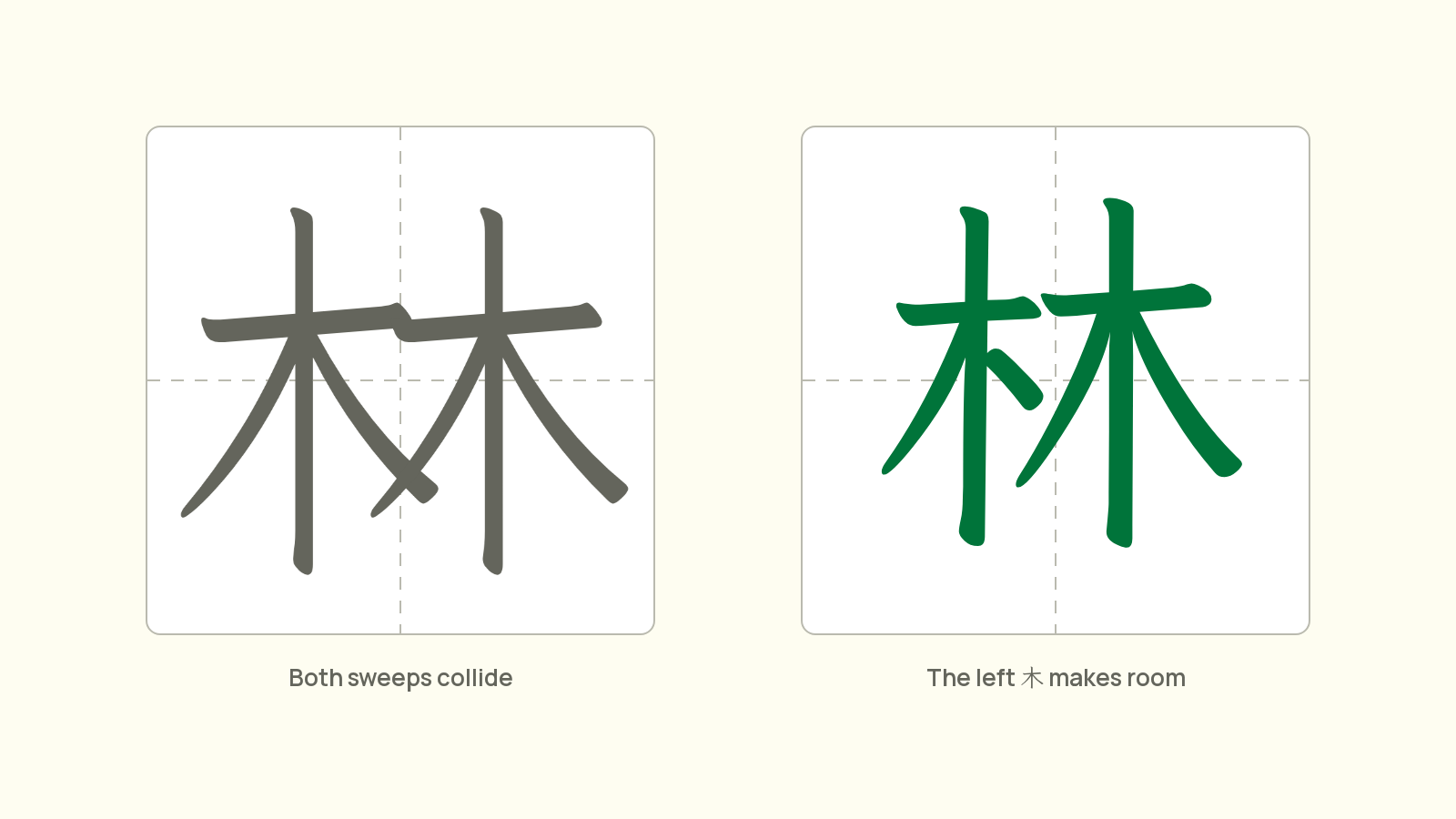
必 shows the difference. Mainland GF 0023-2020 writes it as left dot, hook (the curve you also write in 心), top dot, slash (丿), right dot (GF 0023-2020). Taiwan’s data has left dot, hook, top dot, right dot, and the long slash last (Taiwan MoE look-up for 必). Same five strokes, but Taiwan finishes the 心 shape before the slash.
Calligraphy schools differ too, and native speakers disagree on a few characters: one Reddit thread argues over 九 (thread two). Some variation is normal.
Pick the standard that matches your script and stick to it. For simplified characters, that is the mainland one.
In my view, this matters less than it feels. A teacher reading your page sees only the finished character. If a variant order still produces the right character, most readers will never know, and it is not “wrong Chinese”. It only becomes a problem when it makes your characters messy or hard to read.
How to learn stroke order without memorising a rulebook
Watch the order once, trace once, then write from memory. Only check the order again when the shape comes out wrong. Count your strokes as a quick self-check: if you wrote four where the character has five, something is missing. Do this in a short daily session, not one long cram.
On Strokie’s practice screen, the glossary sits under the board and replays a character’s stroke order. Replay is free for the first HSK level and part of Pro for the others. Then you trace eight guided cells and write twelve free ones. Strokie checks your stroke count and the overall shape of what you wrote, not the order, so the replay is there for you to look at before you write.
Sources
- X post: how you can tell how Chinese an artist is by their square
- Reddit r/ChineseLanguage: Does the stroke order in Chinese really matter?
- Reddit r/ChineseLanguage: How much of a purist are you about stroke order?
- GF 0023-2020 通用规范汉字笔顺规范 (PDF)
- PRC Ministry of Education notice that GF 0023-2020 took effect
- Taiwan Ministry of Education stroke-order site FAQ with the 17 basic rules
- Taiwan Ministry of Education stroke-order look-up for 必
- Sun, Wang and Yu (2024), System 122, 103295
- Sun, Wang and Yu (2024), Computer Assisted Language Learning 39(4)
- Chang, Tang, Lee and Chen (2022), Frontiers in Psychology 13
- Hou and Jiang (2022), Frontiers in Psychology
Put the method into practice.
Strokie replays each character's stroke order on the practice screen, then has you trace it and write it from memory with Apple Pencil.
Download on the App Store