Why writing Hanzi from memory beats tracing alone
Can read a Chinese character but not write it? Why tracing alone falls short, how to practice writing Hanzi from memory, and how often, with the research.
On this page
You can read a character you cannot write because the two jobs are different. Reading only has to recognize a shape you have seen before. Writing has to build every part of it, in order, with nothing in front of you.
Tracing and copying keep the answer on the page the whole time. A blank page does not.
I found no study comparing tracing with writing from memory in adult learners of Chinese. So this post leans on nearby evidence: children copying made-up characters, beginners learning real ones, and memory research on prose, word pairs, and trivia. Where I give my own opinion as a teacher, I say so.
Why can you read a character you cannot write?
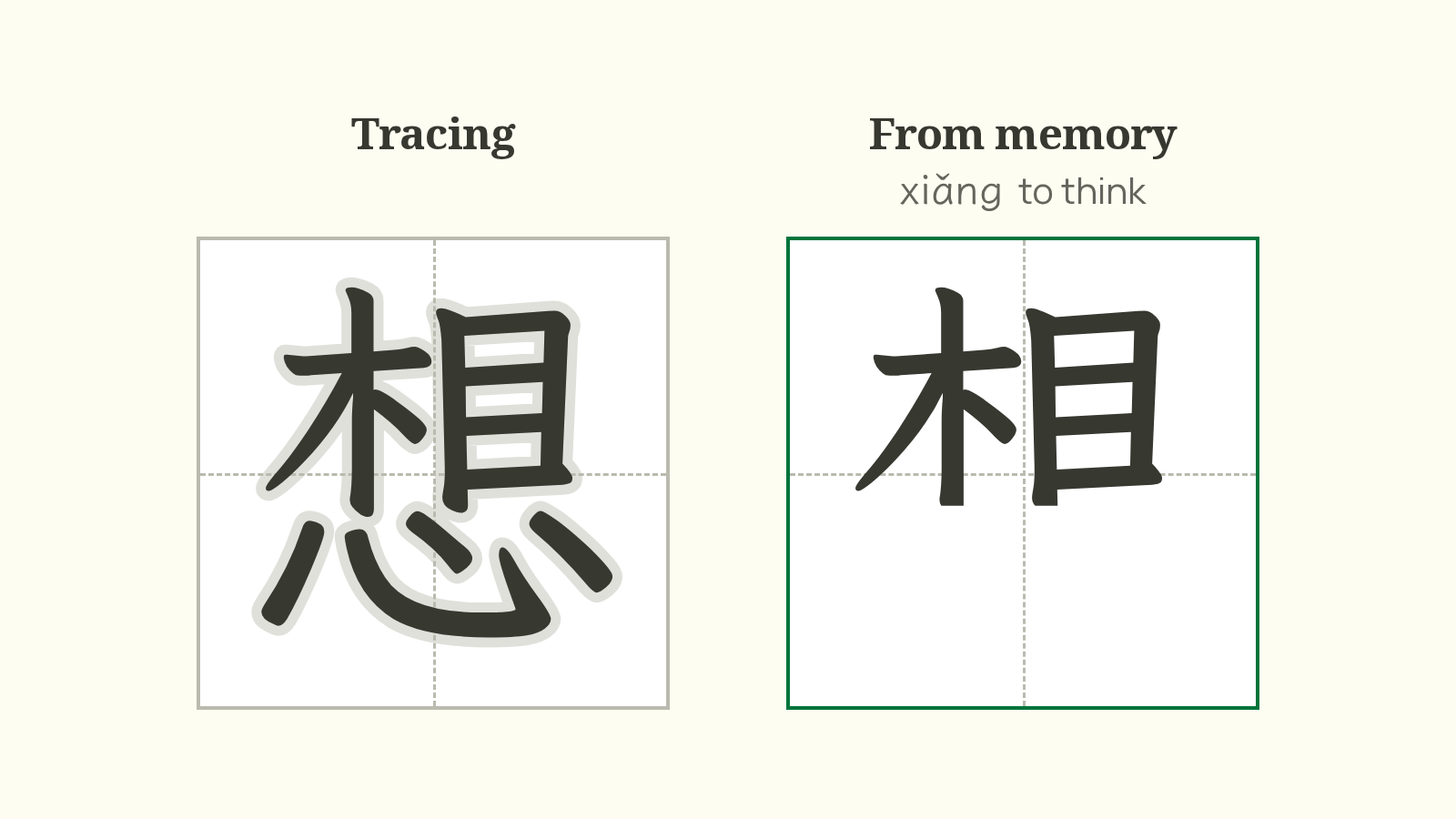
Take 想, “to think”. You meet it in a sentence and know it at once. Now cover it, read “xiǎng”, and try to write it. You might produce 相 on top and then stall. The 心 underneath was never something you had to supply, because reading never asked you to.
This is normal, even for people who grew up with the script. A 2021 analysis of handwriting data found that native-speaking university students showed character amnesia, failing to write a character they know, for about 42% of characters and about 6% of the time overall. That is a lab task with native speakers, not learners. Another researcher argues that much of the older, popular evidence for “character amnesia” is unreliable, so treat sweeping claims with care. The safe takeaway is narrower: knowing a character and producing it are separate skills.
Why can you write it with a model but not on a blank page?
Because the model does the hard part. When you trace, you follow a character that is already there, and your hand can finish a neat 想 without you ever deciding what comes next.
In Naka’s 1998 study, Japanese schoolchildren learned made-up character-like shapes. Tracing gave weaker recall than copying into a blank box next to the model. The author’s explanation was that a traced shape is always there, so you never have to hold an image of it in your head. The caveats are big: children, invented characters, a test one minute later, and tracing compared with copying, not recall. Treat it as a hint, not a verdict.
A visible model also makes you feel you know the character. In a classic experiment on prose passages, students who kept rereading were the most confident about next week and remembered the least a week later. Koriat and Bjork describe the same trap: with the answer in view while you study, you feel competent in a way the test later disproves. Neither study involved tracing, but the trap fits a learner’s complaint: they can write characters when they see them, but not on blank paper.
What does writing from memory add?
The closest study I found is Kang’s 2010 study. Participants with no Chinese studied English words paired with Chinese characters. Some restudied the pairs. Others tried to retrieve each character, with the answer shown afterward. On a later test, within a day, the retrieval group was better at writing or drawing the characters. They also failed to predict it. They were beginners recalling in their heads, not on paper, over short delays.
The answer shown afterward matters. Pashler and colleagues found that giving the correct answer after a wrong response raised word-pair retention a week later by a large margin, while feedback after right answers changed little. So check after you try, and look hardest after a miss.
Here is the loop I would use, built on those findings:
- Cue: read the pinyin and meaning, or a word you know. Keep the Hanzi hidden.
- Write: make one full attempt. Leave gaps instead of peeking.
- Check: reveal the model and find the one or two differences. For 想, it might be the missing 心.
- Again: hide the model and write the whole character once more.
- Return: try it cold the next day.
Start with three to five characters you can read but cannot write. Any blank surface works: paper, a notes app, or Strokie’s recall quiz.
How many times do you have to write a character?
I found no study that gives a number of repetitions per character, so be suspicious of anyone who does. The evidence I can offer counts sessions, not copies.
In Karpicke and Roediger’s 2008 study, students learned Swahili-English word pairs. Once a pair was recalled correctly, some students kept testing it and others dropped it. A week later, the keep-testing groups remembered about four pairs in five, and the drop-it groups about one in three. Studying a pair again after one success added nothing measurable. For you, one correct write is not the finish line.
Spacing helps too. In Cepeda and colleagues’ 2008 study, adults learned obscure trivia facts, and for a test a week later the best gap before the review was about a day. Those are facts, not characters, so “see it again tomorrow” is my extrapolation.
One forum regular said in a 2006 learner thread that ten writes in one day will not last a month, but one write every three days for a month will. That is opinion, not research, but it points the same way.
My rule of thumb: call a character learned when it comes out right on different days, not when you have copied it many times.
Is copying over and over the right way?
It is not wrong, only limited. You cannot recall a shape you have never looked at, so copy a new character once or twice. Past that, the payoff is short-lived.
In Lu, Ostrow and Heffernan’s 2019 study, college students in an intermediate Chinese class copied each word three times. Asked to write the words from pinyin and English, they wrote better after copying than without it right away, slightly better a day later, and no better after a week. It was one class and ten words, so hold it loosely. Recognition scores were also lower right after practice that included copying, so copying time has a cost.
Someone asked in a 2010 forum thread whether writing from pinyin or English would be more efficient than copying each character several times. The retrieval studies above lean that way: recalling from a cue beat studying again. None tests that exact swap for adult learners of Chinese. I would still make it: cue first, copy only to repair a miss.
Where does tracing fit?
Trace a new character once to see where strokes begin and how the parts share the square, copy it once or twice, then close the model. That is my opinion, but the Naka study is why I would not trace more.
Use the model to meet the character. Use the blank page to find out whether you own it.
Sources
- Huang et al. 2021, character amnesia in Chinese handwriting
- Almog 2018, reassessing the evidence for character amnesia
- Naka 1998, repeated writing and children’s memory for pseudocharacters
- Roediger and Karpicke 2006, test-enhanced learning
- Koriat and Bjork 2005, illusions of competence during study
- Kang 2010, retrieval practice for learning Chinese characters
- Pashler et al. 2005, when feedback helps word learning
- Karpicke and Roediger 2008, the importance of retrieval for learning
- Cepeda et al. 2008, spacing and the timing of reviews
- Lu, Ostrow and Heffernan 2019, Chinese handwriting practice in the classroom
- Chinese-forums.com 2006 thread, how many times to write a character (learner discussion)
- Chinese-forums.com 2010 thread, copying versus writing from pinyin or English (learner discussion)
- Chinese-forums.com 2020 thread, remembering characters for writing (learner discussion)
Put the method into practice.
Strokie's recall quiz gives you the pinyin and meaning, a blank Apple Pencil canvas, an answer check, and another chance to write the character.