How to memorize Chinese characters so you can write them, not just recognize them
Can read a character but not write it from memory? Break it into parts, give it a story, write it cold, and space reviews. A method that sticks.
On this page
A learner asked in an r/learnchinese thread on November 3, 2026: how do you memorize Hanzi well enough to write them? They had tried saying the pinyin while writing each character, and putting new characters into sentences, and they still forgot. The replies went everywhere: write it over and over, use flashcards, try Heisig, make up stories, avoid pinyin.
Here is my answer. You don’t forget a character because you wrote it too few times. You forget it because, to you, it was a random tangle of strokes. Build it out of parts that mean something, then test it on a blank page.
The short answer: a five-step method
- Split the character into parts you already know.
- Give the parts a job, meaning or sound, and make a story from them.
- Learn the character inside a word.
- Write it from memory, then check it.
- Come back to it on a widening schedule, and add only a few new characters each day.
The first two steps make a character worth remembering. The last three make sure you can still write it next month. Each has its own section below.
Why “write it 50 times” fades
Writing a character fifty times feels like work, and it is. But most of it is copying. Your hand repeats the shape while your head does very little.
Helen Shen tested this with learners of Chinese in a 2004 study. Some students memorized characters by rote. Others elaborated on each character, either on their own or guided by the instructor. Deeper processing gave significantly better recall of sound and meaning than rote learning. Guided elaboration beat self-made elaboration after 20 minutes, but that edge was gone after 48 hours.
One caveat: the study tested sound and meaning, not handwriting. It tells you that thinking about a character beats repeating it. It doesn’t tell you how well you will write it.
Copying has a second problem: the answer stays in front of you the whole time. I covered that in why writing from memory beats tracing, so I won’t repeat those studies here.
Step 1: Break every character into parts you already know
Learn components as you meet them, not 214 radicals as a list
Many learners start by memorizing the full radical list. I wouldn’t. A list of 214 shapes, most of which you won’t see for months, is the same rote work this post is trying to replace.
A 2007 study by Shen and Ke points the same way. They looked at three skills in learners of Chinese: knowing radicals, spotting them inside characters, and applying them to work out new words. The three grew at different rates. The skill linked to word learning was the applied one, with a moderate positive association. That is a correlation, not proof, but it fits a simple idea: knowing a part from a list is not the same as using it.
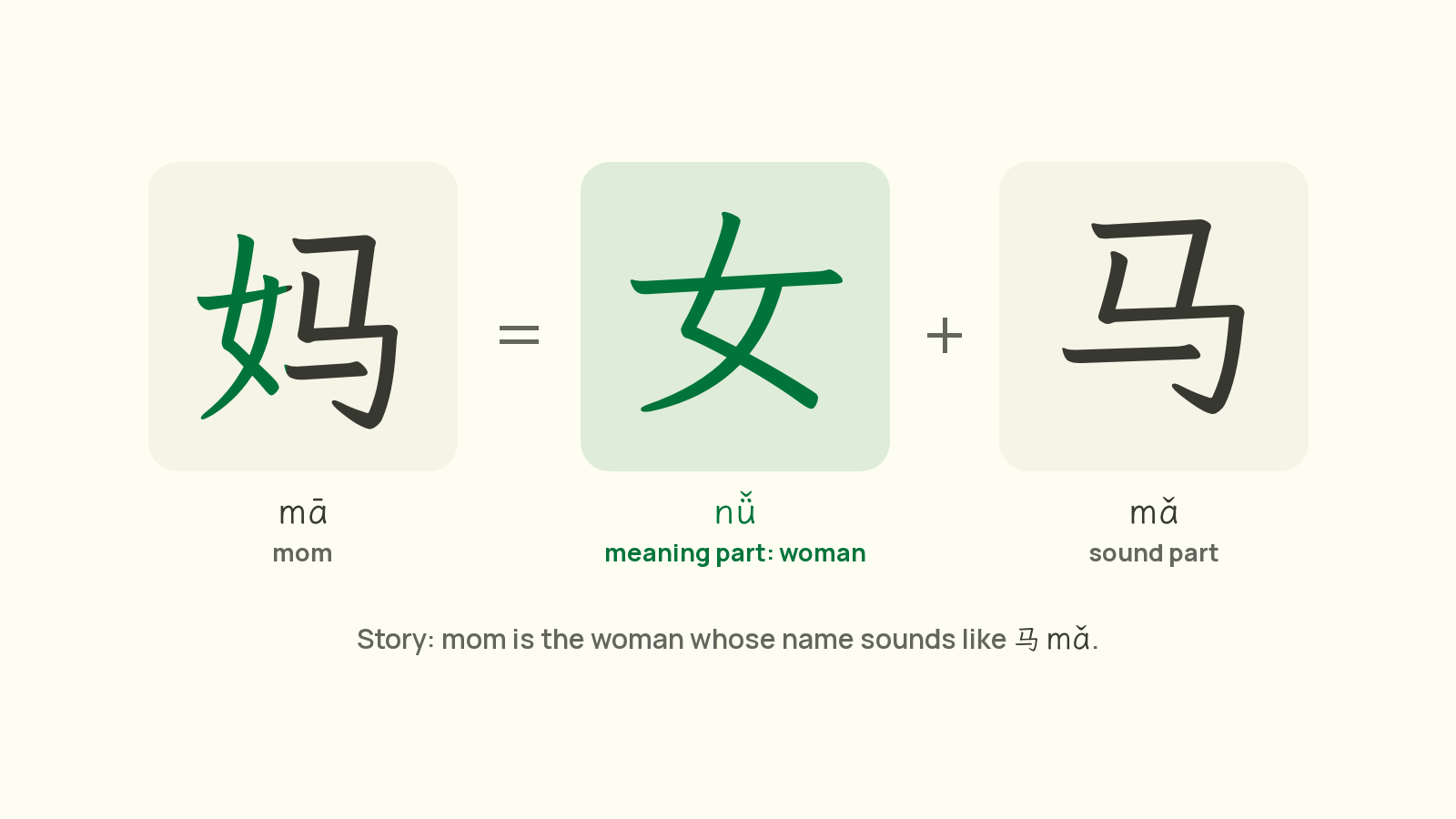
So learn a part when a character hands it to you. 好, “good”, is 女 (woman) plus 子 (child). Once you own 女, it shows up again in 妈, “mom”: 女 plus 马. In 妈, 女 carries the meaning and 马 carries the sound.
Meaning parts and sound parts, and where the sound hint stops working
Many characters pair a meaning part with a sound part. The sound part rarely gives you the exact syllable, but it gets you close.
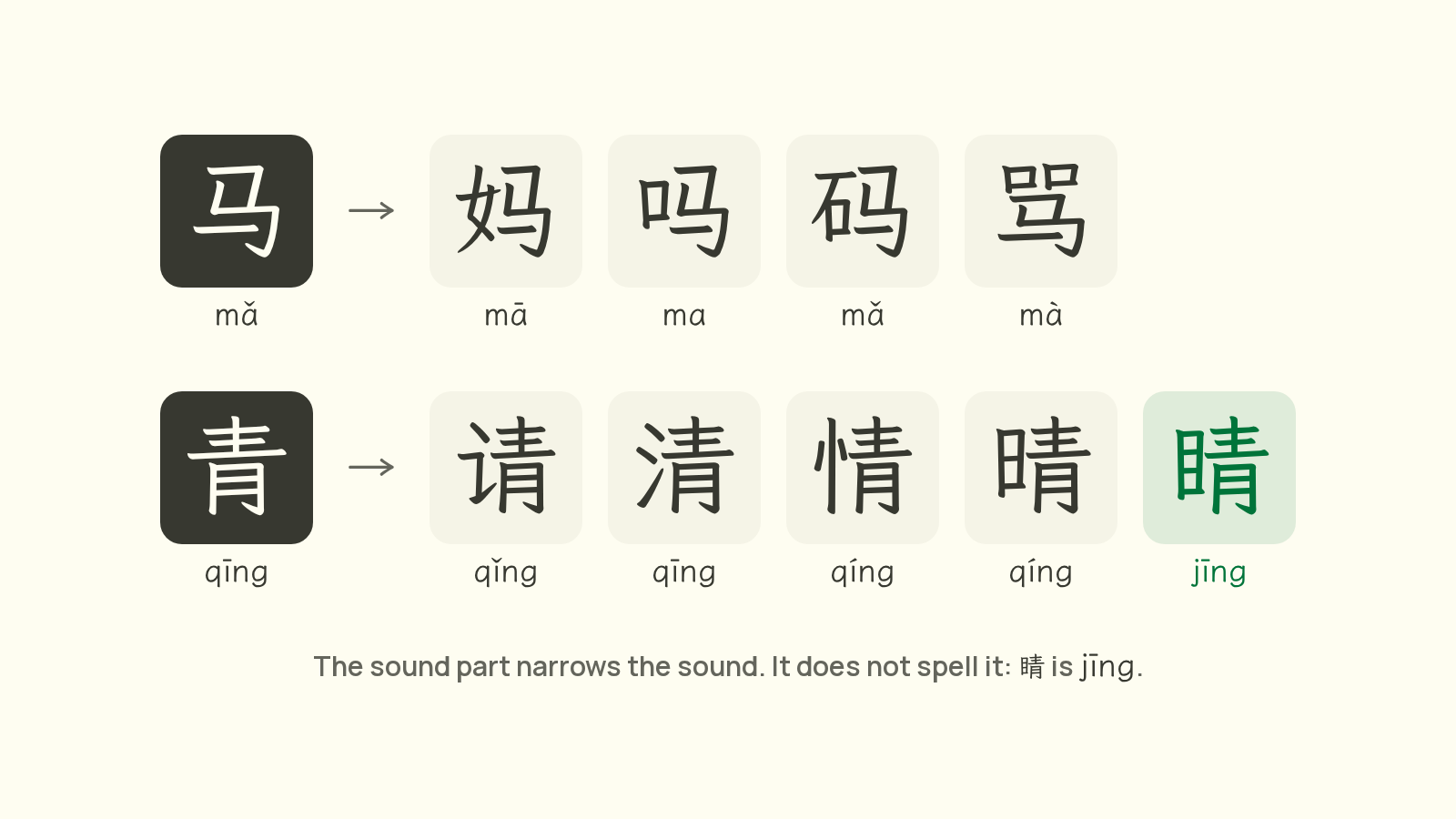
马 mǎ gives you 妈 mā, 吗 ma, 码 mǎ, and 骂 mà: the same syllable, with the tone varying. 青 qīng gives you 请 qǐng, 清 qīng, 情 qíng, and 晴 qíng. Then 睛, “eyeball”, is jīng.
Treat the sound part as a hint that narrows the sound. It doesn’t spell it. You still check the tone, and sometimes the first letter, in a dictionary.
You will see claims about what share of characters work this way. I haven’t verified one, so I won’t give a number.
The handful of parts worth knowing early
These parts turn up constantly in beginner vocabulary. Learn each one the first time you meet it in a real character.
| Part | Common name | Usually about | Examples |
|---|---|---|---|
| 亻 | 单人旁, person side | people | 你, 他 |
| 氵 | 三点水, three drops of water | water, liquid | 河, 洗 |
| 扌 | 提手旁, hand side | things you do with your hands | 打, 找 |
| 口 | 口字旁, mouth side | mouth, speech, sounds | 吃, 叫 |
| 女 | 女字旁, woman side | women, family | 妈, 姐 |
| 木 | 木字旁, tree side | trees, wood | 林, 树 |
| 讠 | 言字旁, speech side | words, speaking | 说, 话 |
| 忄 / 心 | 竖心旁 / 心字底, heart | feelings, thinking | 情, 想 |
| 艹 | 草字头, grass top | plants | 草, 花 |
| 宀 | 宝盖头, roof | houses, shelter | 家, 安 |
Take “usually” at its word. These are tendencies, not rules, and some characters use a part for its look or its sound alone.
Step 2: Make a story, and make it your own
Once you have the parts, connect them with a short story. The story turns 女 and 马 into one thing you remember.
Kuo and Hooper tested this with 92 high-school students learning Chinese characters in a computer lesson. The students were split into five groups: plain translation, verbal mnemonics, visual mnemonics, both together, and mnemonics the students made up themselves. The students who made their own scored higher than the visual, verbal, and translation groups. They also took longer. These were teenagers in one computer-based lesson, so hold the result loosely. It does fit a common experience: a story you built is easier to find again than one you were handed.
What makes a good story:
- Use the real meanings when they help. 好 is a woman with her child, and that is good.
- Make it vivid. A picture you can see beats a clever sentence.
- Keep it to one sentence. If you can’t say it quickly, you won’t use it during a review.
If you want a full system rather than making up your own, one reply in the thread recommended Heisig and Richardson’s Remembering Simplified Hanzi. It gives each character a keyword and builds stories from named parts in a fixed order. Some learners like the structure. Others find the invented keywords get in the way. Try a few chapters before you commit.
One limit: a story gets the right parts into the right places. It doesn’t tell your hand the details, like which stroke is longer or where a hook turns. That still comes from writing and checking.
Step 3: Separate look-alikes on purpose
Some characters fail not because you forget them, but because you write their twin instead. 理 and 埋 differ only in the left part.
A 2022 study by Chang and colleagues worked on exactly this. Sixty-six learners past the beginner stage studied look-alike characters with three strategies: a picture that links the shape to the meaning, that picture plus a short memorable phrase, or the stroke sequence alone. Right after learning, the picture-plus-phrase strategy gave the best writing scores, and its lead was clearest when look-alike pairs were studied side by side. A week later, none of the strategies held a writing edge. All three worked for reading. For the order itself, see does stroke order matter.
So a good hook gets the pair right at the start. A week later the edge was gone, so spaced reviews in step five are my answer to that fade.
How I would use that:
- Study the twins together. Put the two characters next to each other and name the difference out loud.
- Give the difference a meaning. 买 mǎi is “buy”. 卖 mài is “sell”, and it’s 买 with 十 on top: when you sell what you bought, you add ten. 休 is a person resting against a tree. 体, “body”, swaps the tree for 本, “root”: your body is the person’s root.
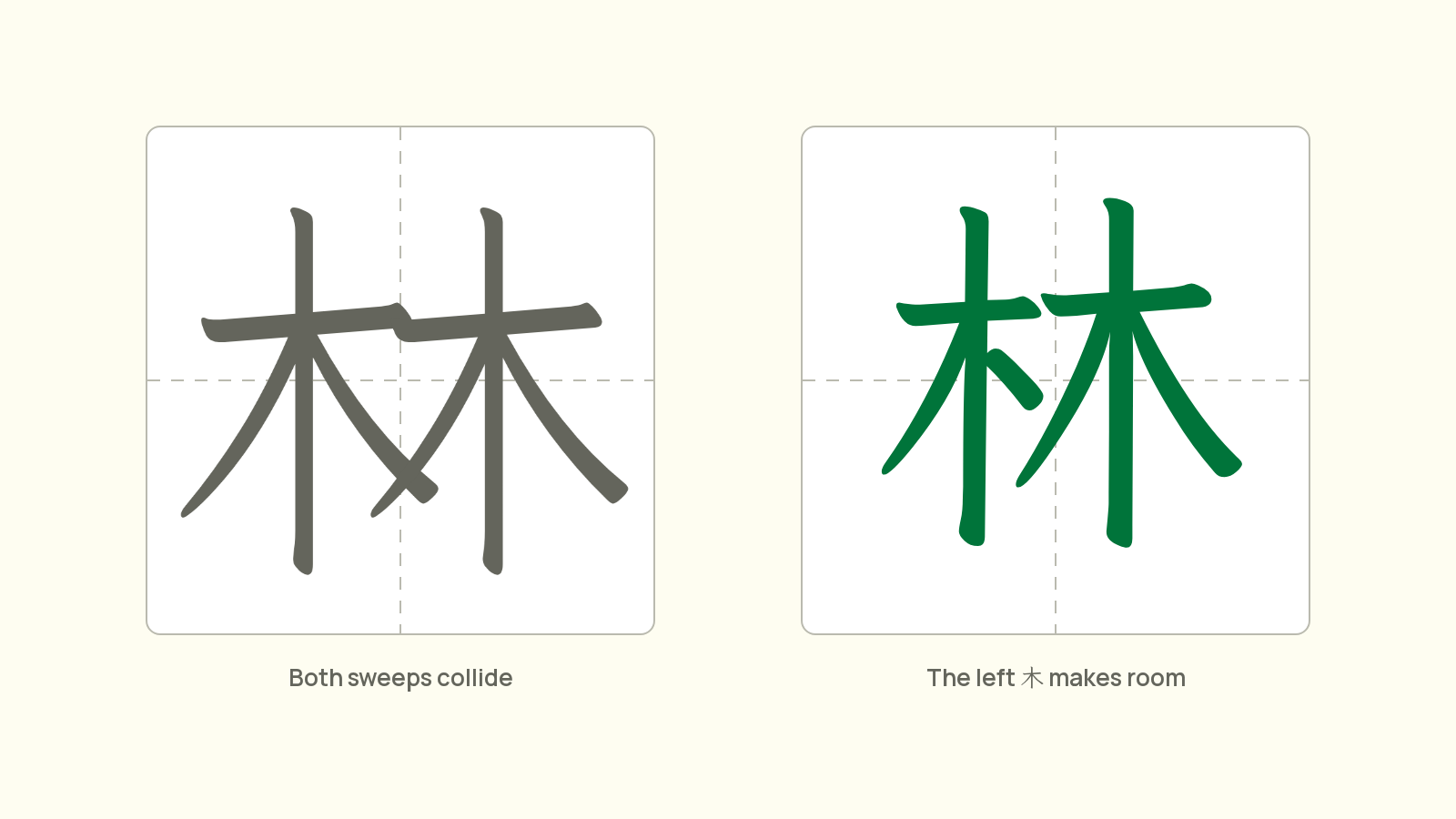
Some look-alikes differ only in stroke length, like 土 and 士. Those need a proportion check, not a story. See why your Chinese handwriting looks messy.
Step 4: Learn characters inside words you’ll actually use
You will almost never write 想 on its own. You will write 想要, “to want”, or 我想去, “I want to go”. So learn it there.
A word gives the character something to come back from. When the cue is “I want to go”, you aren’t hunting for a lonely shape. You are finishing a phrase you know: 我想去, with 想 in the middle. Replies in the same thread said this too: learn characters in vocabulary, not in isolation, and write short sentences.
That’s opinion, mine and theirs, not a research finding. It costs nothing, and it gives you better cues.
The practical rule: when you review, write the whole word from memory, not only the character you’re studying. For 想要, write both characters, even if only 想 is new.
Step 5: Prove it on a blank page, then space it out
This step makes the others count. Cover the character and read the pinyin and meaning. Write it from memory, then uncover it, find the one thing you missed, and write it once more. For 想, that might be the 心 you left off the bottom. The reasons this beats copying are in why writing from memory beats tracing.
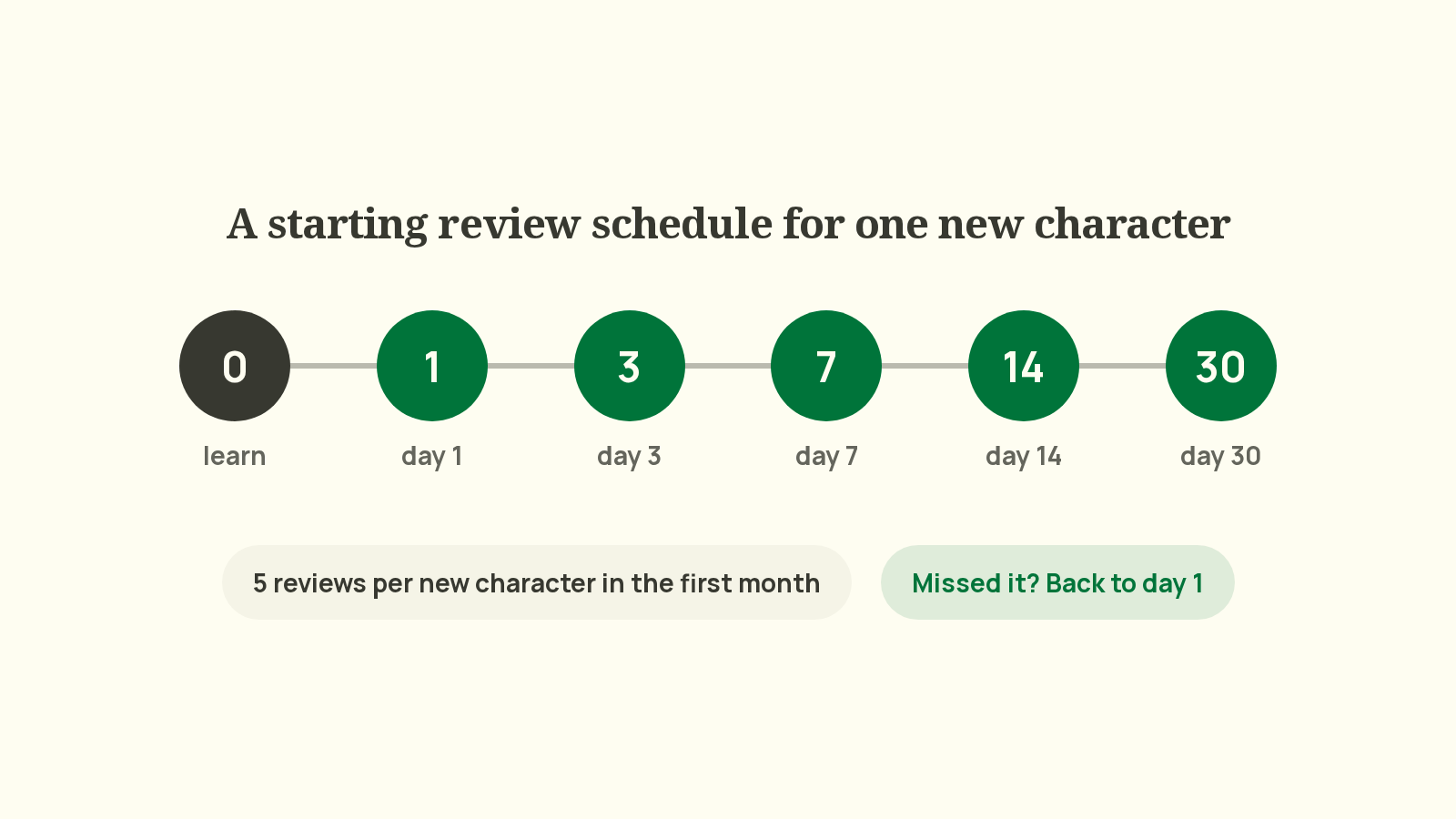
Then come back to it on a widening schedule. Here is the one I would start with:
| Review | When |
|---|---|
| Learn it | Day 0 |
| First review | Day 1 |
| Second review | Day 3 |
| Third review | Day 7 |
| Fourth review | Day 14 |
| Fifth review | Day 30 |
Treat it as a starting point, not a research-derived schedule. When you miss a character, move it back to day 1. Missing a new character the next day is common; one learner asked if it was normal, and it is. Plan for that review instead of feeling bad about it.
How many new characters a day?
As many as your reviews allow. The arithmetic below is my own illustration, not a study.
With the schedule above, each new character costs five reviews in its first month. So once you have kept a steady pace for a month, your daily reviews run at about five times your daily new count. Five new characters a day means about twenty-five reviews a day. Ten means about fifty. Twenty means about a hundred. Misses that go back to day one add more.
Writing reviews take longer than tapping a flashcard, because each one is a full character on a blank square. I would start with five a day and raise it only while your reviews stay short.
If you have a target in mind, such as an exam level, see how many characters you need for targets.
A 15-minute daily session that puts it together
Here is how I would fit the method into fifteen minutes:
- Reviews first. Write every character that’s due from memory. This takes about five to eight minutes.
- Fix the misses. Trace each missed character once, say its story as you go, then write it twice from memory.
- Add today’s new characters. For each one, find the parts, make the story, put it in a word, and do the first cold write.
If you practice in Strokie, its recall quiz runs over the characters you’ve saved. It shows the pinyin and meaning, and you write each character from memory. Then you reveal the answer and mark it yourself, or turn on auto-grading. The characters you miss go to Review next, and Today puts them first among the characters to practice. Practice misses gives each missed character two cells with a faint guide and four free cells, which is close to the fix-the-misses step above.
For the setup itself, I wrote a separate guide to a short daily session on iPad.
FAQ
Is it normal to forget a character the next day?
Yes. Learners ask this often, and even native speakers fail to write characters they know; the source is in why writing from memory beats tracing. That is why the first review comes the next day.
Should I learn radicals first?
Not as a list. Learn parts as they show up in the characters you’re learning, as in step one. The radical study above found that applying parts is what goes with word learning.
Pinyin or characters first?
Use pinyin as the cue you write from, not as the thing you memorize. If you can say xiǎng but cannot write 想, writing from that cue is how you close the gap.
Sources
- Shen 2004, level of cognitive processing and character learning
- Shen and Ke 2007, radical awareness and word acquisition
- Kuo and Hooper 2004, visual and verbal mnemonics for Chinese characters
- Chang, Tang, Lee and Chen 2022, visual mnemonics for look-alike characters
- Heisig and Richardson, Remembering Simplified Hanzi 1 (University of Hawaii Press)
- r/learnchinese thread, how do you memorize your Hanzi (learner discussion, November 2026)
- r/ChineseLanguage thread, forgetting new characters the next day (learner discussion, October 2026)
Put the method into practice.
Strokie's recall quiz shows the sound and meaning, gives you a blank square to write in, and brings the characters you miss back first.
Download on the App Store