Why your Chinese handwriting looks messy (and the fixes that actually help)
Stroke order is only the start. Fix stroke length, spacing, component proportions, model choice, and practice size to make Hanzi look steadier.
On this page
The complaint is simple: I know the stroke order, I practise a lot, and it still looks ugly. One learner put it almost exactly that way in an X post. The good news is that your writing is probably more legible than you think.
Once the order is right, the next problem is usually proportion: which stroke is longest, where it sits, and how much of the square each component gets. Those are visible problems. You can learn to spot them.
First, check: is it wrong or just untidy?
Hacking Chinese separates intent from execution. Intent is the character in your head. Execution is what your hand puts on the page.
Write one character five times without changing your model. If the same part is too short every time, your mental image is probably wrong. Go back to the model. If the flaw moves around, your image may be fine and your hand needs slower practice.
This distinction saves time. More repetition helps execution. It does not repair a mistaken model, because you are rehearsing the same mistake.
The first goal is correct, readable writing, not calligraphy. Harvey Dam’s minimum requirements focus on stroke length, direction, and placement. Stroke thickness is not essential. A pencil or a plain stylus is enough.
And do not grade yourself harder than a reader would. In the “destined for bad handwriting” discussion, many replies said the learner’s writing was already legible. Untidy is not the same as wrong.
Fix 1: Only one stroke gets to be long
One useful regular-script rule is that only one thing should reach far to the right. It may be a long horizontal, a sweep, or a hook. The difference between that main stroke and the others should be obvious, according to Dam’s handwriting guide.
Look at 三. The first two horizontals are about the same length. The bottom one is clearly longer. If all three fight for the full width, the character loses its hierarchy.
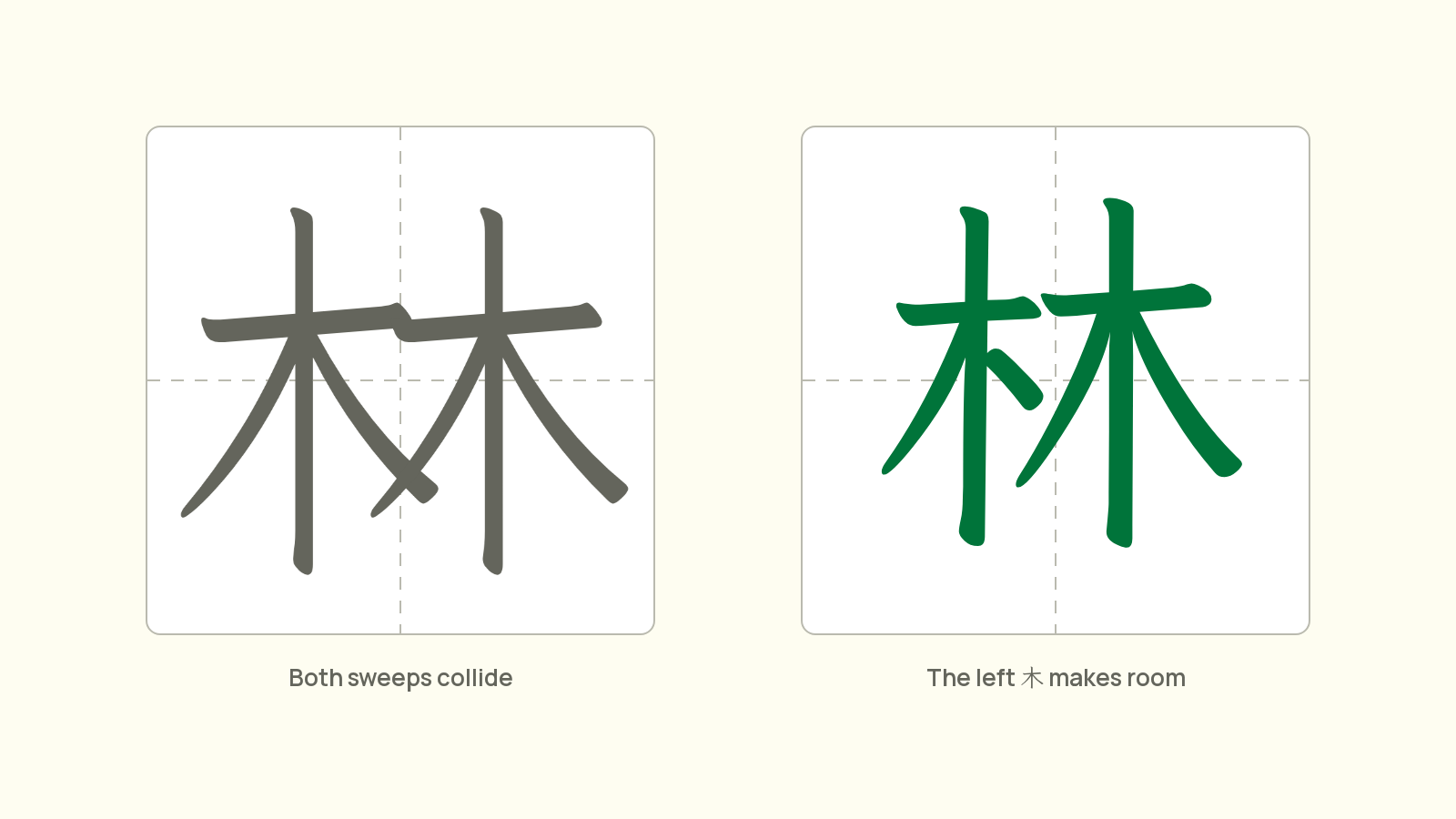
林 applies the same idea across components. The left 木 gives up its final sweep and uses a dot, leaving room for the right 木. If both sides sweep fully to the right, they collide.
春 shows why this is a structural rule, not a copying trick. Writing 三, 人, and 日 as three untouched blocks creates competing rightward strokes. The parts change shape when they share one character.
Before you copy again, inspect the main stroke the way Dam suggests: name its type, find where it starts, note what it passes through, and mark where it ends. Write the character, then check those same points. “It looks off” becomes a specific correction.
Fix 2: Some lengths change the character itself
Sometimes proportion is not cosmetic. It decides which character you wrote.
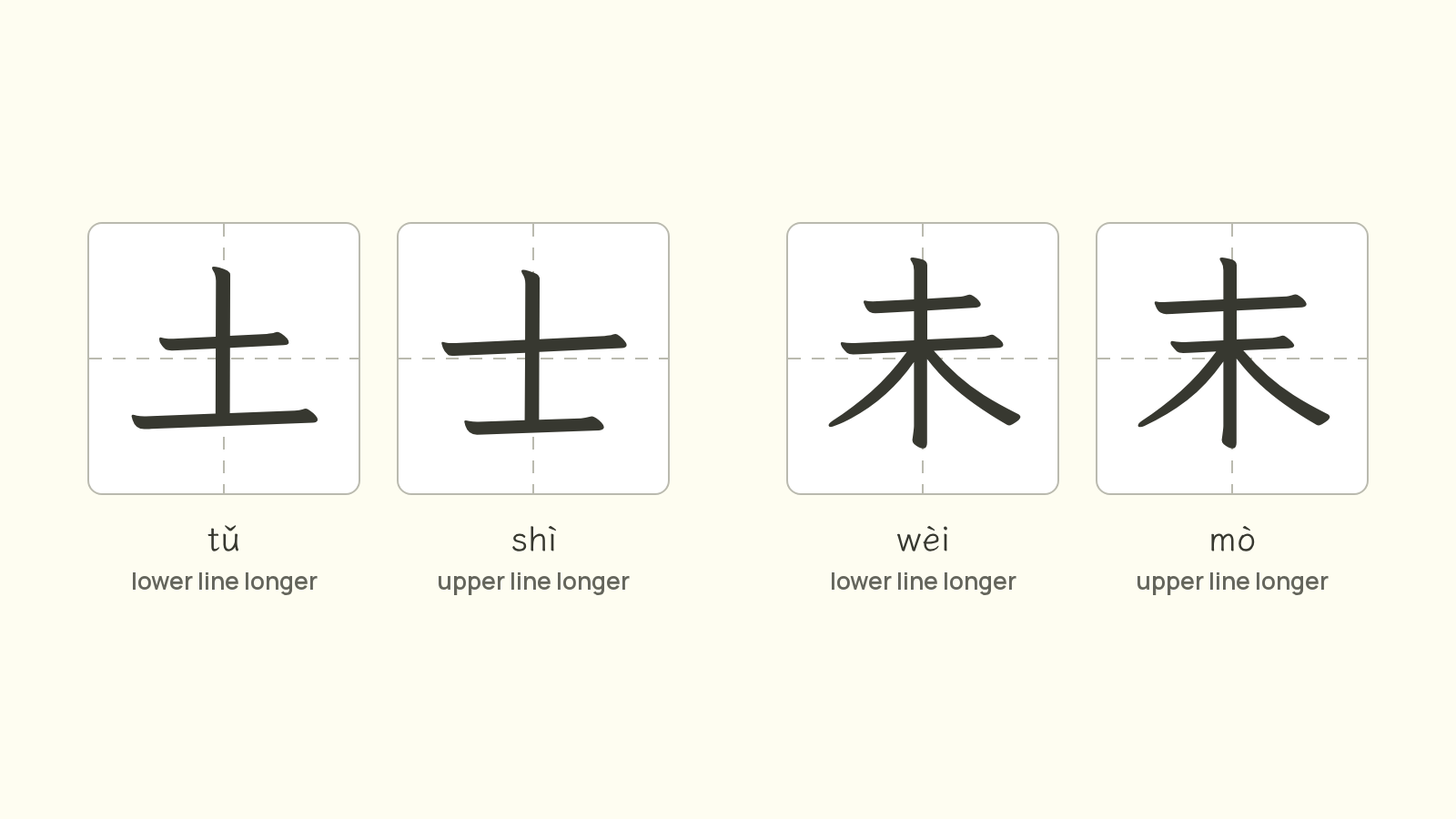
In 土, the lower horizontal is longer. In 士, the upper horizontal is longer. 未 and 末 use the same contrast: 未 has the longer lower horizontal, while 末 has the longer upper one. These distinctions are documented in a secondary similar-character guide. Hacking Chinese uses 未 and 末 as an example of intent versus sloppy execution.
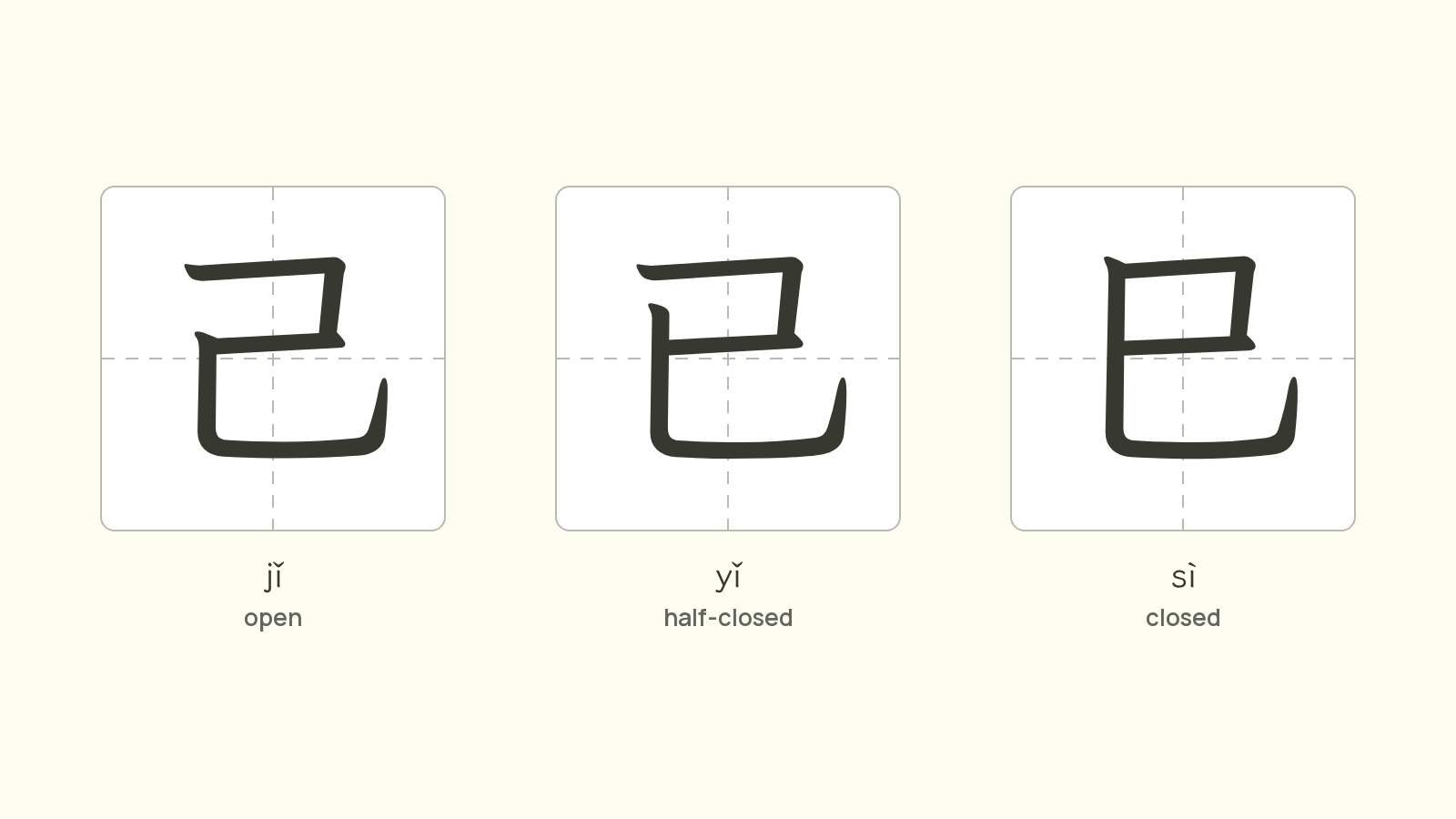
己, 已, and 巳 make the same point with placement rather than length. In standard models, compare how far the vertical rises: 己 stays open, 已 is half-closed, and 巳 is closed. Hacking Chinese uses the trio to show why placement belongs in your mental image. Check a dictionary model rather than leaving the distinction for your hand to guess.
Fix 3: Components share the box. They don’t each get their own
Beginners often draw each component as if it had a full square, then squeeze the results together. A character is one square. Its components negotiate that space.
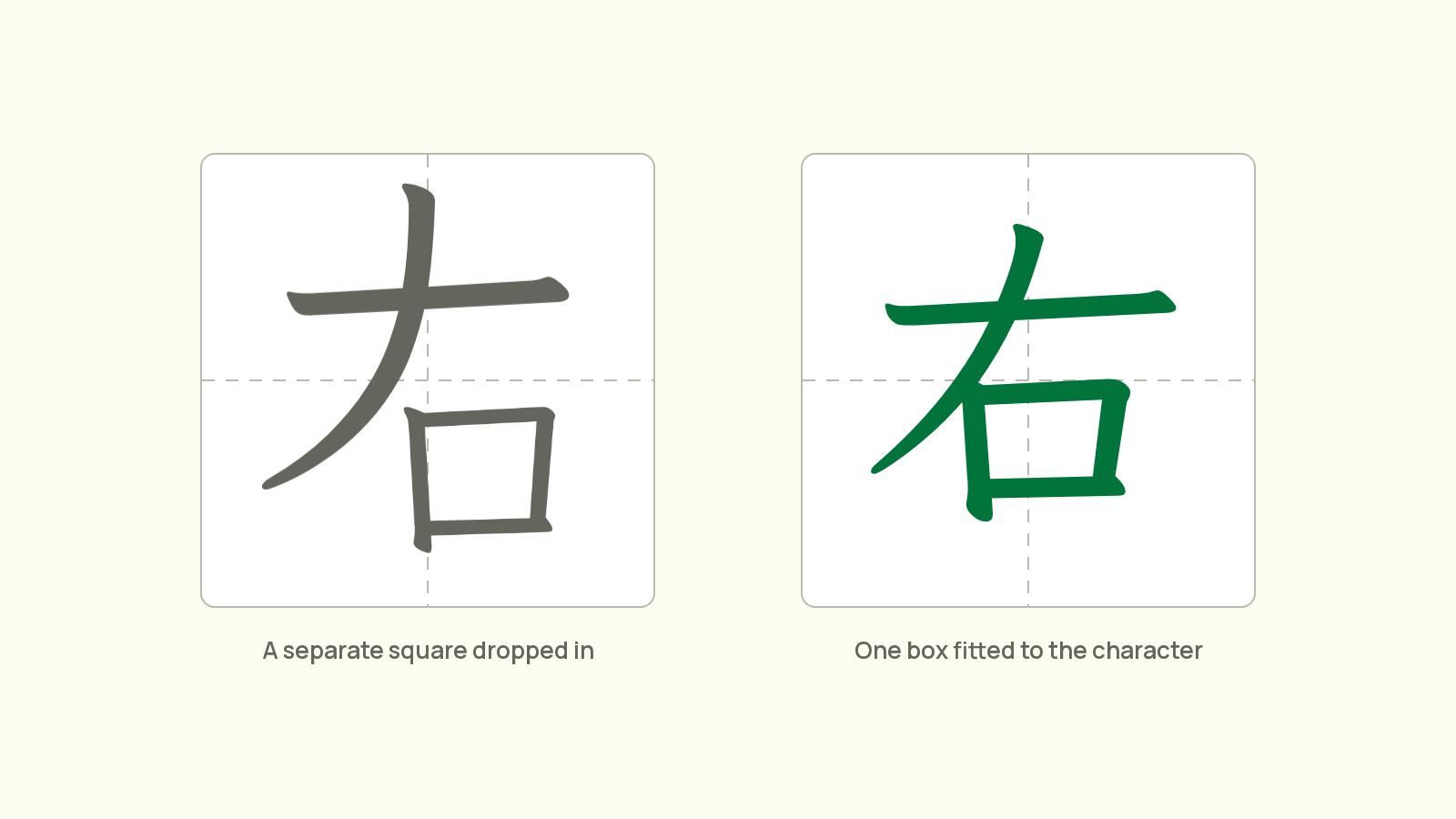
The 口 inside 右 does not need to be a perfect geometric square. Apply the same principle when 口 repeats inside 品: copy the compound’s arrangement instead of stacking three isolated squares. In 相, 目 sits taller and narrower. The comments specifically call out 右 and 相 in a learner critique discussion.
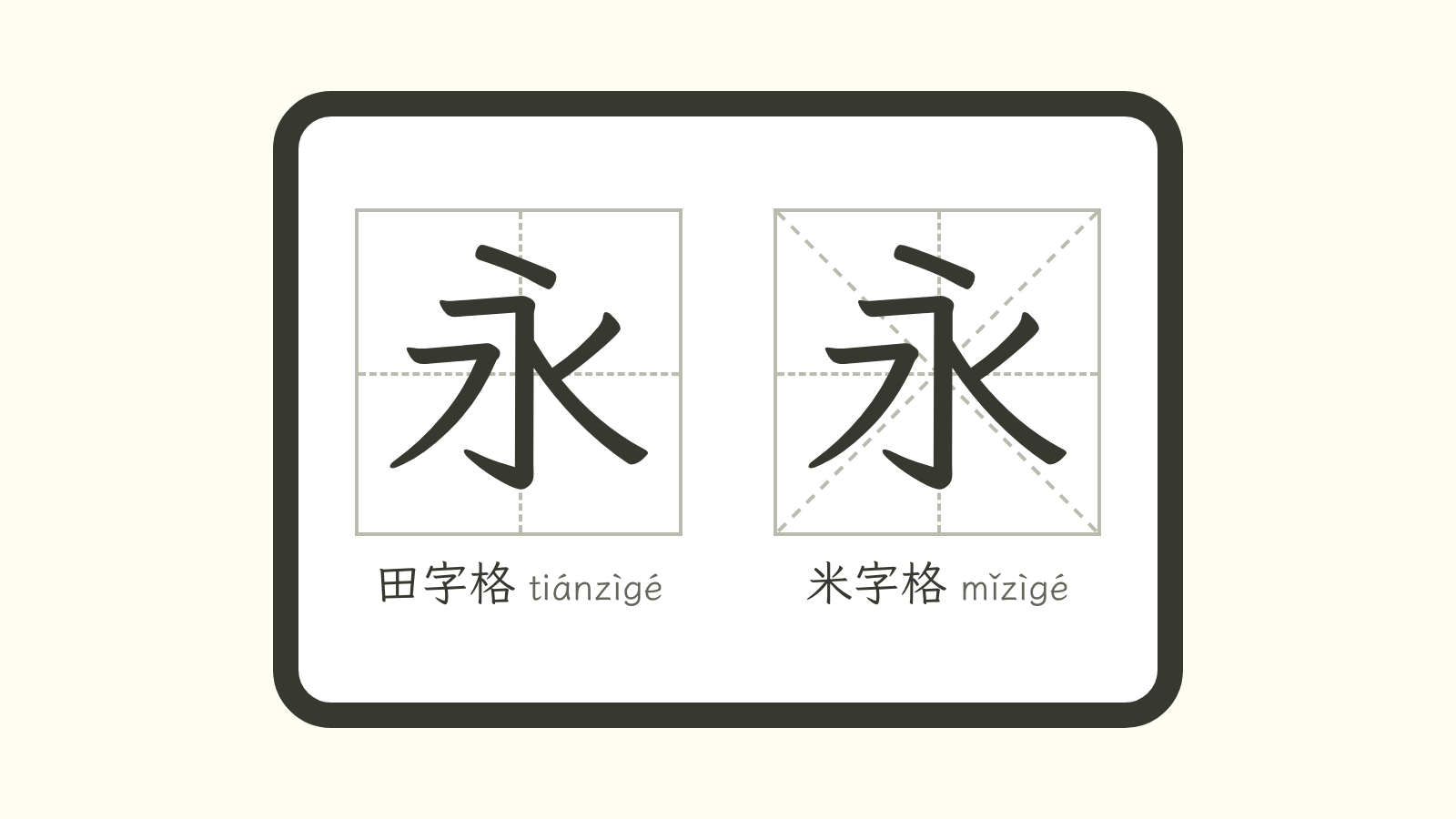
Chinese pupils are taught structure, 间架结构, after strokes and stroke order. The 2022 curriculum mirror tells pupils in grades 1-2 to learn basic strokes, common components, stroke-order rules, and character structure. A primary-school teaching article gives the sequence 笔画, then 笔顺, then 结构. It uses 田字格 to observe where strokes start and stop, how the character fills the cell, and how components fit together.
Use the centre lines that way. Compare where the model crosses them, which empty spaces repeat, and how much of the cell the whole character occupies.
Fix 4: The tricky “few strokes, lots of space” characters (心)
心 is hard because it has only four strokes, three of them dots, but it still has to fill the square. That problem came up directly in the learner discussion.
It is also an exception to the long-stroke rule. Dam notes that its hook points left and that 心 does not follow the usual rightmost-extension pattern. Memorise that exception with the character.
Do not turn “short and wide” into another rigid rule. Look at several handwritten or regular-script examples in a 书法字典 instead. Note where each stroke starts, what it passes, and where it ends. Then choose one model and stay consistent.
Fix 5: Practise big and slow, against a good model, then shrink
Small writing hides mistakes. Let one character fill a 2 by 2 block of ordinary grid cells, write slowly, and look back at the model after every attempt. That advice recurs in the “destined for bad handwriting” thread and matches Hacking Chinese’s advice to use grid paper and mimic a target model.
A Kaiti-style font is the practical starting model recommended in the learner discussion. For a stronger model, Dam recommends a 书法字典 and regular-script examples by Ouyang Xun, Yan Zhenqing, or Liu Gongquan. Pick one standard instead of borrowing a different shape each time.
Work on one visible error per attempt. Check the longest stroke. Check where the main vertical lands. Check whether the components still fit inside one square.
Tracing can help you study shape, but recall is what makes the character available later. Write from memory after you study the model. Then use a short daily session. Spreading practice out is better than one long session every month.
Sources
- Hacking Chinese: How to improve your Chinese handwriting
- Harvey Dam: Handwriting Chinese characters, the minimum requirements
- X learner post about stroke order and ugly handwriting
- Reddit learner discussion: Am I destined for bad handwriting?
- Reddit learner discussion: Why is 心 so hard to write?
- 2022 PRC school curriculum mirror
- Primary-school regular-script teaching article
- Secondary guide to similar characters
- 9610 书法字典
Put the method into practice.
Pick one clear regular-script model, write large enough to see the proportions, and correct one repeatable flaw at a time.
Download on the App Store