How many Chinese characters do you actually need? (And the 1,200 HSK 3.0 wants you to write)
About 1,000 characters cover most everyday text, but reading, handwriting, vocabulary, and HSK targets are four different counts.
On this page
About 1,000 Chinese characters cover roughly 90% of running text. About 2,500 cover 98% to 99%, depending on what you read. That does not mean 1,000 characters let you understand 90% of a newspaper. Character coverage is not word knowledge.
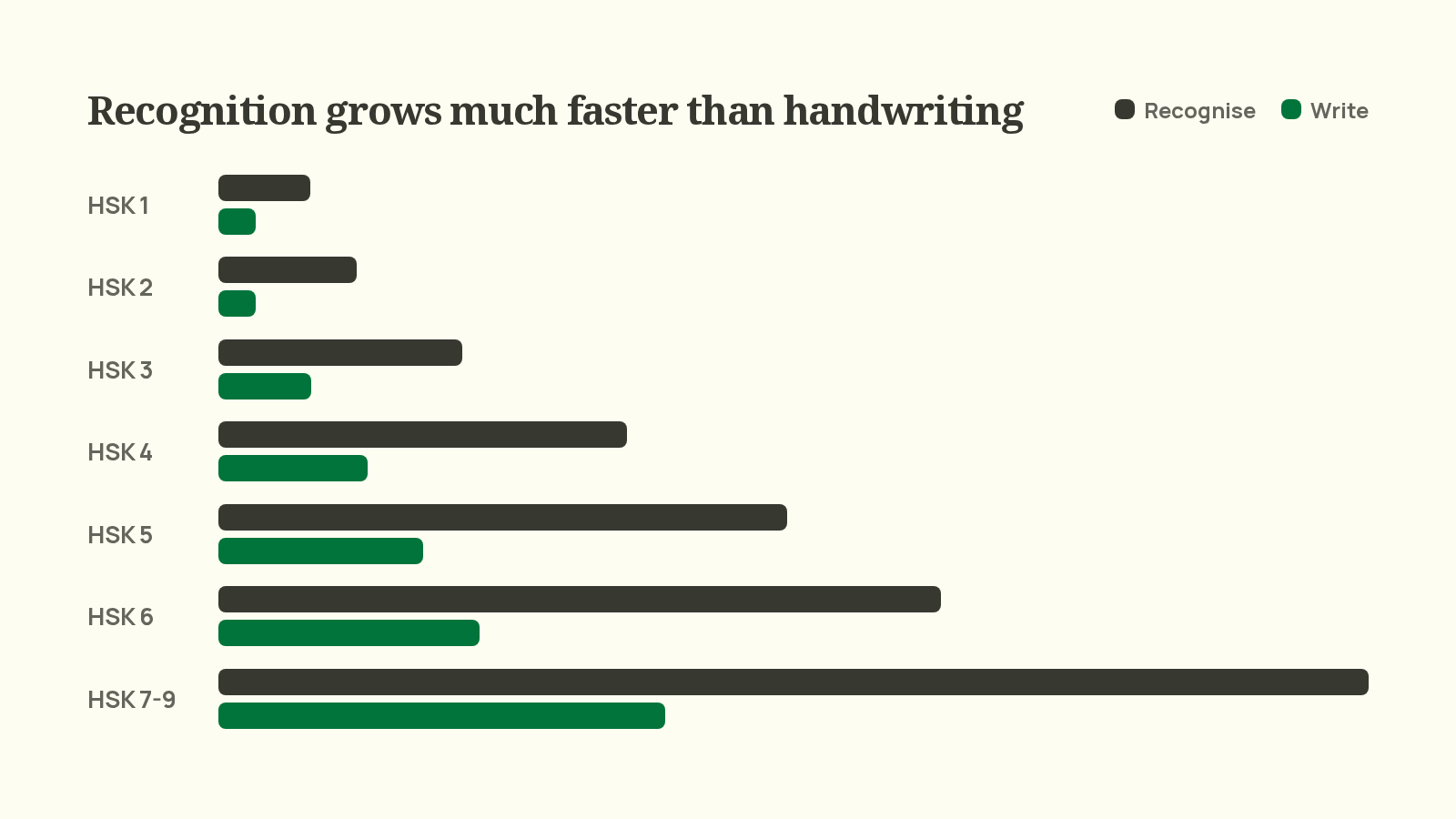
For the new exam, the official HSK syllabus expects you to recognise 1,940 characters by HSK 6, but write 700. At levels 7-9, the writing total reaches 1,200. Reading and writing are separate counts. Most quick answers blur them, or repeat the older 2021 standard instead of the current exam syllabus.
The short answer: reading needs far more characters than writing
HSK now labels its character lists 认读字, characters you recognise, and 书写字, characters you write. That split is sensible. You meet far more characters while reading than you need to produce with a pen.
Chinese schools make the same distinction. By the end of primary school, the 2022 curriculum mirror says pupils should recognise about 3,000 characters and write about 2,500. A reading target is not automatically a handwriting target.
Here is the current HSK picture. Recognition and word totals are cumulative. The writing totals are cumulative sums from the separate lists in the 2025 syllabus.
| Level | Read | Write | Words |
|---|---|---|---|
| 1 | 246 | 100 (shared) | 300 |
| 2 | 371 | 100 | 500 |
| 3 | 655 | 250 | 1,000 |
| 4 | 1,096 | 400 | 2,000 |
| 5 | 1,527 | 550 | 3,600 |
| 6 | 1,940 | 700 | 5,400 |
| 7-9 | about 3,000 | 1,200 | 11,000 |
The gap is already clear at level 3: the syllabus asks for 655 recognised characters and 250 written ones. By level 6, those totals are 1,940 and 700. Treating the recognition column as a handwriting assignment would more than double the list you need to practise with a pen.
The first writing list is unusual: levels 1 and 2 share one list of 100 characters. There is no separate level 1 list. For levels 7-9, 3,088 is the number of recognition-list entries, not a verified unique-character total. Polyphonic characters can appear more than once. That is why “about 3,000” is more honest than presenting 3,088 as a count of unique characters.
How many characters do you need to read Chinese?
Coverage numbers: what 500, 1,000, 2,000 and 3,000 characters get you
Frequency lists give a useful answer, as long as you ask what kind of text they counted. Jun Da’s list comes from modern written material. SUBTLEX-CH comes from film and television subtitles. The subtitle list reaches each coverage threshold with fewer characters.
These thresholds were computed from the Jun Da written-text list and SUBTLEX-CH.
| Coverage | Written text | Subtitles |
|---|---|---|
| 50% | 152 | 62 |
| 80% | 611 | 356 |
| 90% | 1,057 | 717 |
| 95% | 1,566 | 1,111 |
| 98% | 2,285 | 1,668 |
| 99% | 2,838 | 2,076 |
That is why “about 1,000” is a useful first answer. The top 1,000 cover 89.1% of Jun Da’s written corpus and 94.0% of SUBTLEX-CH subtitles. At 2,000, coverage reaches 97.1% and 98.9%. In written text, 3,000 reaches 99.2%.
With 500 characters, you have not yet reached 90% in either list. The written corpus needs 611 characters for 80%, while subtitles need 356. That is enough to make common material feel less dense, but frequent gaps remain. The curve gets expensive near the top: moving from 98% to 99% takes hundreds more characters.
A separate secondary analysis of the Academia Sinica corpus found similar thresholds for traditional text: 1,030 characters for 90%, 1,510 for 95%, and 2,700 for 99%. Different corpora move the line, but not enough to turn 500 characters into newspaper literacy.
Why 98% of characters still isn’t “reading”
Characters combine into words. You can know 东 and 西 separately and still not know that 东西 means “thing”. The characters are familiar; the word is not.
The same problem appears whenever familiar pieces form an unfamiliar compound. Character coverage tells you that the shapes on the page are known. It does not tell you that you know which sense applies, how the characters group into words, or what the whole sentence is doing. Those are vocabulary and grammar problems, not missing-character problems.
This is why character coverage and comprehension must stay separate. The often quoted 98% threshold comes from research on word coverage in English fiction, not Chinese character coverage. A 2023 replication found a gradual relationship rather than one fixed threshold.
There is no comparable verified threshold here that says a certain percentage of Chinese characters guarantees comfortable reading. Use coverage to estimate how often an unknown shape appears. Do not use it as a promise that the sentence will make sense.
”To read a newspaper”: what native benchmarks say
The PRC’s literacy-campaign regulation sets 1,500 characters for farmers and 2,000 for workers and urban residents, together with the ability to read simple newspapers and write simple practical texts. That is a basic literacy benchmark, not a fluency score.
Other lists aim higher. The 1988 common-character list has 2,500 common characters plus 1,000 less-common ones, according to a secondary summary. The State Council’s 2013 standard character table has 3,500 first-tier common characters. Taiwan’s common standard-form table has 4,808, according to a secondary overview.
For native news or web text, 2,000 to 3,000 recognised characters is a useful working range, plus the vocabulary and grammar to turn those characters into meaning. There is no magic newspaper number.
How many characters does HSK 3.0 make you write?
The official writing list (书写字), level by level
The official syllabus prints a numbered writing list for each band. It does not print running totals, so the cumulative column below is simple addition.
| Syllabus list | New writing characters | Cumulative |
|---|---|---|
| HSK 1-2, shared | 100 | 100 |
| HSK 3 | 150 | 250 |
| HSK 4 | 150 | 400 |
| HSK 5 | 150 | 550 |
| HSK 6 | 150 | 700 |
| HSK 7-9 | 500 | 1,200 |
This clears up one common bit of confusion in the official list: “550 characters for HSK 5” means 550 in total through level 5. It does not mean level 5 adds another 550.
Every one of the 250 writing characters through level 3 also appears in the 655-character recognition set through that level in the syllabus. You learn to recognise the larger set and produce the smaller one.
The writing list isn’t a frequency list
The writing list is curated for the syllabus. It is not simply the 1,200 most frequent characters.
The surprising proof is in the official lists: 看, 就, 想, 能, and 到 appear on none of the six writing lists, even though all five rank in the top 40 of SUBTLEX-CH. By our count from those sources, 261 of the 500 most frequent subtitle characters are absent from the 1,200-character writing set.
For an exam, use the official writing list. For everyday reading and writing, use frequency and the material you actually meet. Those are different jobs.
What the papers actually ask you to write
The official HSK 3.0 sample papers show how quickly “writing” changes from one level to the next.
| Level | Writing section | What you do |
|---|---|---|
| 1 | None | Listening and reading only |
| 2 | 10 items, 10 minutes | Supply components and missing characters |
| 3 | 10 items, 20 minutes | Write characters from pinyin, then sentences from given words |
| 4 | 6 items, 25 minutes | Write picture sentences and a text of at least 80 字 |
| 5 | 2 items, 40 minutes | Write a picture story of at least 100 字 and an essay of at least 200 字 |
| 6 | 2 items, 45 minutes | Write a practical text of at least 150 字 and an essay of at least 300 字 |
Both paper and computer forms exist. Test-takers report that the computer version uses pinyin input, but I did not find an official statement confirming that. If your centre offers only paper, the writing list matters in the most literal way.
Dates: when HSK 3.0 actually starts
As of October 26, 2026, the formal global launch is December 13, 2026. The launch notice repost gives a November 16 deadline for paper-test registration and a December 3 deadline for the computer test, both in Beijing time.
Some centres still list HSK 2.0 dates before that launch. For example, BNTU Minsk advertised a November 8, 2026 sitting under the older version. Check the exact version with your centre rather than trusting a generic course label.
HSK 3.0 vs HSK 2.0 vs the 2021 standard: why the numbers you’ve seen don’t match
Three systems are often confused. The 2021 national standard gave a broad proficiency framework. The 2025 exam syllabus supplies the lists for the exam that launches in 2026. HSK 2.0 is the older six-level format.
Sources for the comparison are the 2025 exam syllabus, the 2021 standard, and a secondary HSK 2.0 summary.
| Level | HSK 2.0 approx. | 2021 read / write | 2025 read / write |
|---|---|---|---|
| 1 | about 174 | 300 / 100 | 246 / 100 shared |
| 2 | about 348 | 600 / 200 | 371 / 100 |
| 3 | about 618 | 900 / 300 | 655 / 250 |
| 4 | about 1,064 | 1,200 / 400 | 1,096 / 400 |
| 5 | about 1,685 | 1,500 / 550 | 1,527 / 550 |
| 6 | about 2,663 | 1,800 / 700 | 1,940 / 700 |
| 7-9 | Not used | 3,000 / 1,200 | about 3,088 entries / 1,200 |
The HSK 2.0 character counts are derived from its word lists, not separately published official character lists, so treat them as approximate. It had no separate writing-character list. The phrase “300 characters per level” belongs to the 2021 standard. It does not describe the 2025 exam lists.
The word target changed too. HSK 3 means 1,000 cumulative words in the new syllabus, compared with 600 in the secondary summary of the old format.
So how many should you learn?
Choose the count that matches the job.
- Sitting HSK 1-3 on paper: learn to write the 250 official writing characters and recognise the 655 in the syllabus. Do not turn all 655 into a handwriting target.
- Reading graded readers or subtitles: about 700 to 1,100 recognised characters puts you near 90% to 95% of subtitle character coverage in SUBTLEX-CH. Vocabulary still decides what you understand.
- Reading native web pages or news: aim for 2,000 or more recognised characters. The written-text frequency list reaches 97.1% coverage at 2,000, while the school curriculum mirror keeps writing below recognition.
- Handwriting for memory or enjoyment: keep a smaller core set and choose it by frequency and personal use. A short daily writing session is more realistic than copying every character you can read.
There is no honest universal answer to “how many per day”. The arithmetic is easy: 10 new characters a day covers the 250-character HSK 3 writing list in about 25 days. The reviews are the work. When you practise, write from memory, not trace, so a correct-looking copy does not hide a weak memory.
FAQ
Is 3,000 Chinese characters fluent?
No. In the written-text list, the top 3,000 cover 99.2% of character tokens. Fluency also needs words, grammar, listening, speaking, and enough reading experience to process them together.
How many characters do Chinese people know?
There is no single count for every person. The school curriculum mirror expects about 3,500 recognised characters by the end of grade 9. That is a curriculum benchmark, not a census of adult knowledge.
Do I need to handwrite for HSK 3.0?
On the paper test, yes from level 2 onward: the sample papers include handwriting tasks. Test-takers report that the computer version uses pinyin input, but that detail was not verified from an official source.
Are HSK 2.0 materials still useful?
Yes, for learning the characters and words themselves. No, as a map of the new levels. The secondary old derived counts and the 2025 syllabus lists group material differently.
Sources
- Official Chinese Proficiency Test syllabus, published 2025
- Official HSK 3.0 sample papers
- Jun Da modern Chinese character frequency list
- SUBTLEX-CH paper
- Academia Sinica corpus analysis
- Hu and Nation on English word coverage
- 2023 replication of lexical coverage research
- PRC literacy-campaign regulation
- 2022 PRC school curriculum mirror
- Secondary summary of the 1988 common-character list
- 2013 State Council standard character table
- Secondary overview of Taiwan’s common standard forms
- HSK writing-list discussion
- HSK 3.0 launch notice repost
- BNTU Minsk exam-version notice
- 2021 international Chinese education standard
- Secondary HSK 2.0 level summary
Put the method into practice.
Keep recognition and handwriting as separate targets, then practise only the smaller writing list.
Download on the App Store